
Indonesia Power Summary
Looking into Indonesia’s special power structure, identifying opportunities and difficulties to phase-out coal.
Mapping Indonesia’s Industrial Power System and Energy Transition
Indonesia’s energy transition is increasingly shaped by the growth of industrial power demand. As nickel, aluminium, battery, and EV-related industries expand, so too does the need for electricity systems that can support them. At the same time, renewable energy is growing, new financing is entering the market, and policy ambitions for transition continue to evolve. Yet these developments are not advancing evenly, and they are often analysed in isolation from one another.
Indonesia Power Summary, a new project by Earthwise Institute, brings these strands together through project-level data on Indonesia’s power and industrial energy landscape. The project maps captive coal, captive renewables, utility-scale renewable energy projects, industrial parks, and downstream industrial developments, alongside ownership profiles, geographical patterns, and financing transactions. The datasets cover nickel-related projects, aluminium-related projects, battery and EV manufacturing, renewable energy assets, captive renewable projects, and financier participation across the sector. By bringing these data together in one framework, the project offers a more complete picture of how Indonesia’s industrial expansion, electricity demand, and energy transition are interacting in practice.
The findings show that Indonesia’s power transition is increasingly tied to the structure of industrial development. A large share of the country’s fastest-growing electricity demand is concentrated in a small number of industrial corridors, especially those linked to nickel and aluminium. In these corridors, industrial power systems have already reached a scale equivalent to more than 40% of Indonesia’s total coal power capacity. This means that the pace and direction of Indonesia’s transition will depend not only on national renewable deployment, but also on how industrial power demand is planned, financed, and supplied.
The project includes 3 databases:
Indonesia Captive Coal Database, access full data here.
- Captive Coal Projects
- Owner and Geographical Profile
- Financing Transactions & Financier Profile
- 12 Data-derived Insights on Captive Coal Projects & Financing
- 3 Data-derived Insights on Indonesia Industrial Energy
Indonesia Industrial Power Extended Dimentions Database, access full data here.
- Industrial Park Captive Power Profile
- New Nickel Projects & Power Profile
- New Aluminium Projects & Power Profile
- Downstream (Battery & EV) Projects & Power Profile
Indonesia Renewable Database, access full data here.
- Renewable Projects
- Captive Renewable Projects
- Owner and Geographical Profile
- Financing Transactions & Financier Profile
- 6 Data-derived Insights on Renewables & Energy Transition
Key findings
- Indonesia’s energy transition increasingly runs through industrial power demand.
A large share of Indonesia’s fastest-growing electricity demand is concentrated in a small number of industrial corridors, especially those linked to nickel and aluminium. Earthwise’s analysis shows that industrial power systems in these corridors already reach a scale equivalent to more than 40% of Indonesia’s total coal power capacity. Industrial energy is therefore central to the pace, direction, and credibility of the wider transition. - Industrial energy remains structurally anchored in coal.
Earthwise’s analysis finds that Indonesia already hosts at least 23.954 GW of operating captive coal capacity, with a further 19.160 GW in the pipeline. Taken together, the captive coal fleet is expected to reach at least 43.114 GW in the near future. Coal still supplies 94% of nickel-linked captive power and 77% of aluminium-linked captive power, indicating that the most electricity-intensive parts of industrial growth remain heavily dependent on coal-based energy systems. - Captive coal is highly concentrated and deeply embedded upstream.
The expansion of captive coal is concentrated in a small number of mega industrial parks and closely tied to upstream industrial production. Nickel remains the core anchor of this system, with assets already built and power demand increasingly locked in. This suggests that captive coal is no longer a marginal or temporary feature of industrialisation, but an established part of Indonesia’s industrial power structure. - The future pipeline looks large, but much of it remains contingent.
Project-level analysis shows that the apparent scale of Indonesia’s future captive coal pipeline depends heavily on a relatively small number of developments, especially in aluminium. This means headline capacity figures overstate how much future build-out is actually secured. Project outcomes remain shaped by policy conditions, industrial park development, financing pathways, and the strategic choices of a narrow group of dominant corporate actors. - Aluminium is emerging as the clearest stress point in industrial power planning.
Earthwise finds that Indonesia’s aluminium pipeline implies at least a 4 GW structural electricity gap, even under optimistic assumptions. More than 6.6 GW of implied demand may be relying on “existing” captive coal capacity. This points to a widening mismatch between industrial ambition and credible energy infrastructure planning, and suggests that aluminium-related expansion carries greater structural risk than current pipeline narratives imply. - Renewable expansion and industrial decarbonisation are advancing unevenly.
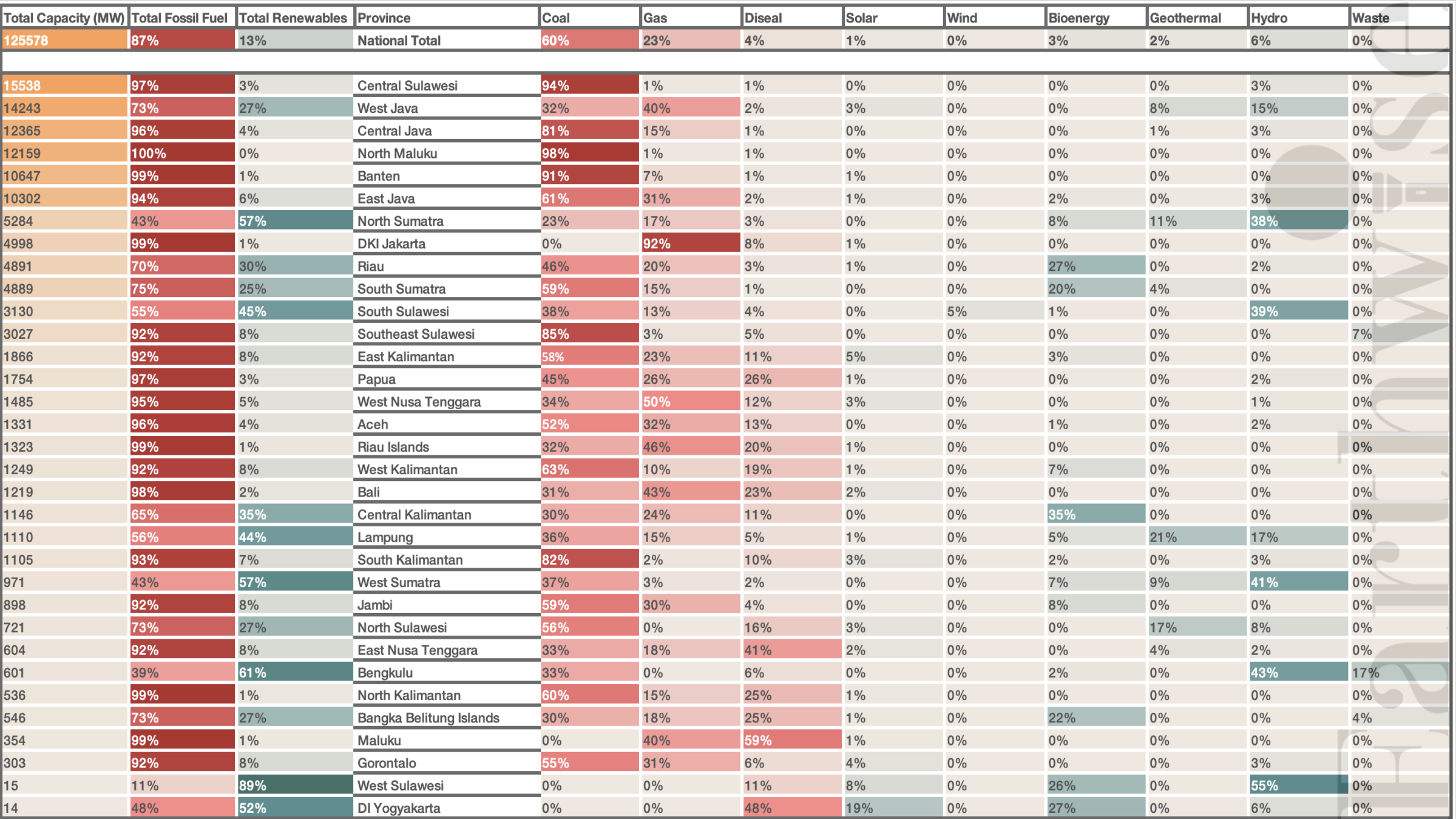
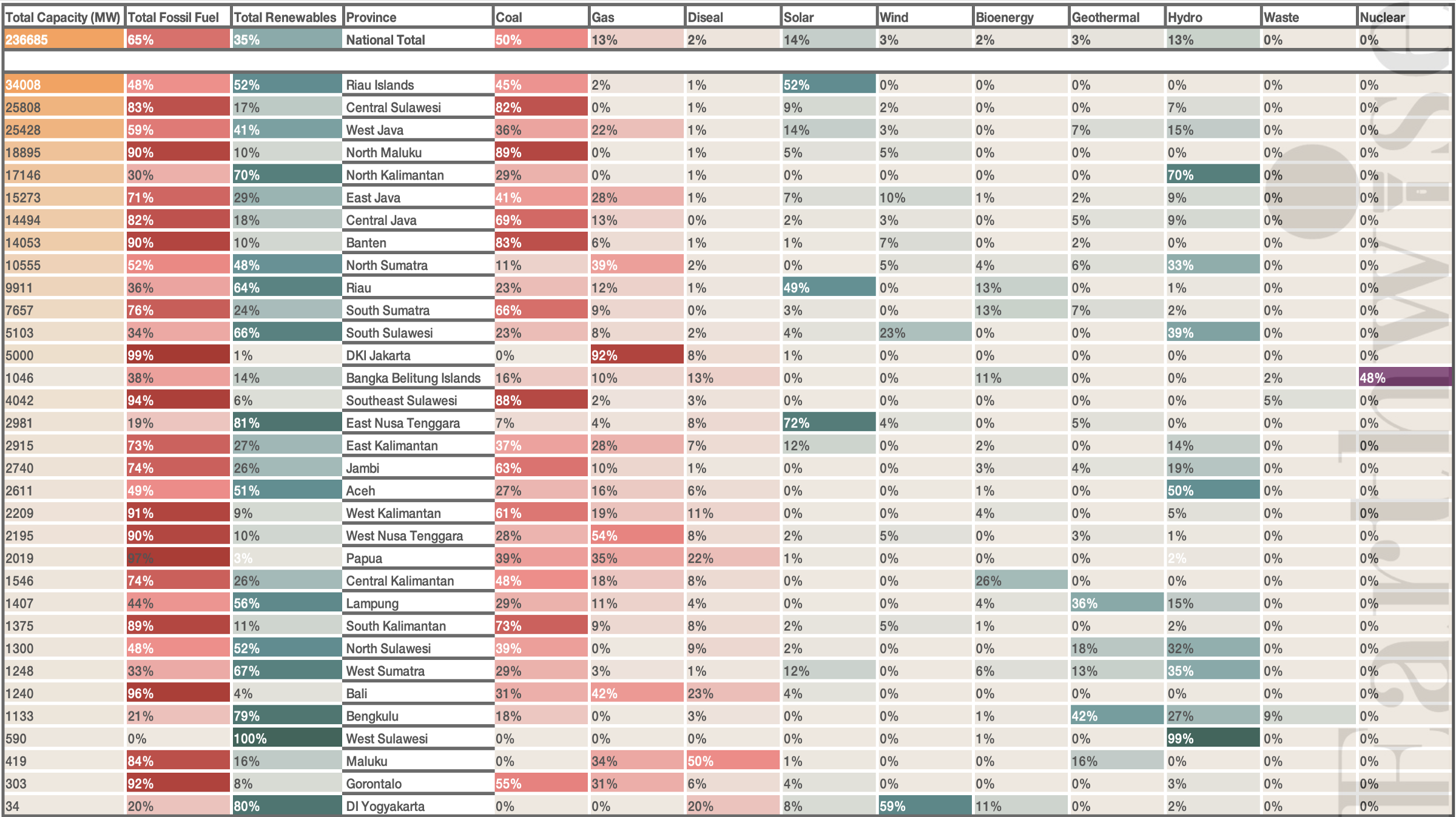
Indonesia could reach around 35% renewables by 2035 if current project pipelines materialise. However, the biggest industrial regions, including major captive-coal and nickel hubs such as Central Sulawesi, North Maluku, and Southeast Sulawesi, remain heavily coal-dependent in projected power mixes. National renewable gains therefore do not automatically translate into decarbonisation in the industrial centres driving demand growth. - The central challenge lies in project delivery.
Indonesia has a large volume of renewable and industrial energy plans, but many projects remain stalled at announcement or pre-construction stage. Earthwise’s cleaned database excludes more than 30 “potential” projects that did not progress to announced status, and similar bottlenecks appear across broader public and utility pipelines. The key challenge is therefore not only ambition, but whether projects can move through planning, financing, and construction into actual delivery. - Finance, disclosure, and supply-chain pressure are becoming more influential in shaping the transition.
Captive coal financing is becoming more commercial and more domestically embedded, while recent renewable financing is increasingly concentrated in a small number of very large transactions. At the same time, green-labelled finance appears to be losing some of its earlier signalling value. Downstream EV and battery projects are increasingly presented through cleaner electricity narratives, even though their upstream industrial base remains closely tied to coal-linked power. This creates a widening governance and transparency gap across the value chain.
Indonesia Power Summary shows that Indonesia’s transition cannot be understood through renewables, coal, or industrial policy in isolation. The country’s energy future is increasingly being shaped by how industrial systems are built, where power demand is concentrated, which projects actually move forward, and whether lower-carbon power can catch up with the scale and speed of industrial expansion.
Related Insights:
Where to Start: Prioritising Captive Renewable Energy Pilots in Indonesia’s Industrial Parks
Captive Renewables Remain Structurally Marginal: 94% of Nickel linked and 77% of Aluminium linked Captive Power in Indonesia Still Supplied by Coal
Indonesia’s Industrial Power System Remains Coal-Anchored Despite Growing Energy Diversity
Indonesia’s Renewable Pipeline Is Failing to Materialise: Structural Barriers, Not Lack of Ambition, Underlie the Captive and On-Grid Delivery Gap
35% Renewables by 2035 – Indonesia’s System Expansion Without Industrial Decarbonisation
Indonesia’s Renewable Market: Mega-Deal Financing Rises and Green Premium Fades
Comparative Case Study Analysis: How Green Power Financing Is Structured in EMDE Heavy Industry
Case Study – PT ENC 200MW Solar Project Financing
Indonesia’s Aluminium Pipeline Reveals a Structural Power Gap of at Least 4 GW
Indonesia’s Nickel Sector Is Becoming Asset-Anchored, While Its EV Downstream Is Diverging from Coal Based Power Pathways
Other Projects:
Climate Tech Lookbook
A structured research platform tracking and classifying climate-relevant technologies across major economic sectors.
Blast Furnace Transition Timelines
A database and methodology mapping blast furnace lifecycles to identify the most practical timing for green upgrade, replacement, and phase-out.
Core Industrial Development In Asia and the Middle East
Research on decarbonization pathways in metals, cement, petrochemicals, and large-scale manufacturing, with a focus on asset-level industrial systems.

The only official website of Earthwise Institute is https://earthwise.institute/
Any other website, domain, or online presence claiming to represent Earthwise Institute, including https://earthwiseinstitute.org/
, is unauthorized and not affiliated with us.
Earthwise Institute is not responsible for any content, communications, requests, or representations made through unauthorized sites.
Copyright © 2026. Earthwise Institute All Rights Reserved.