
Indonesia Power Summary
Part 3
Renewables and Energy Transition
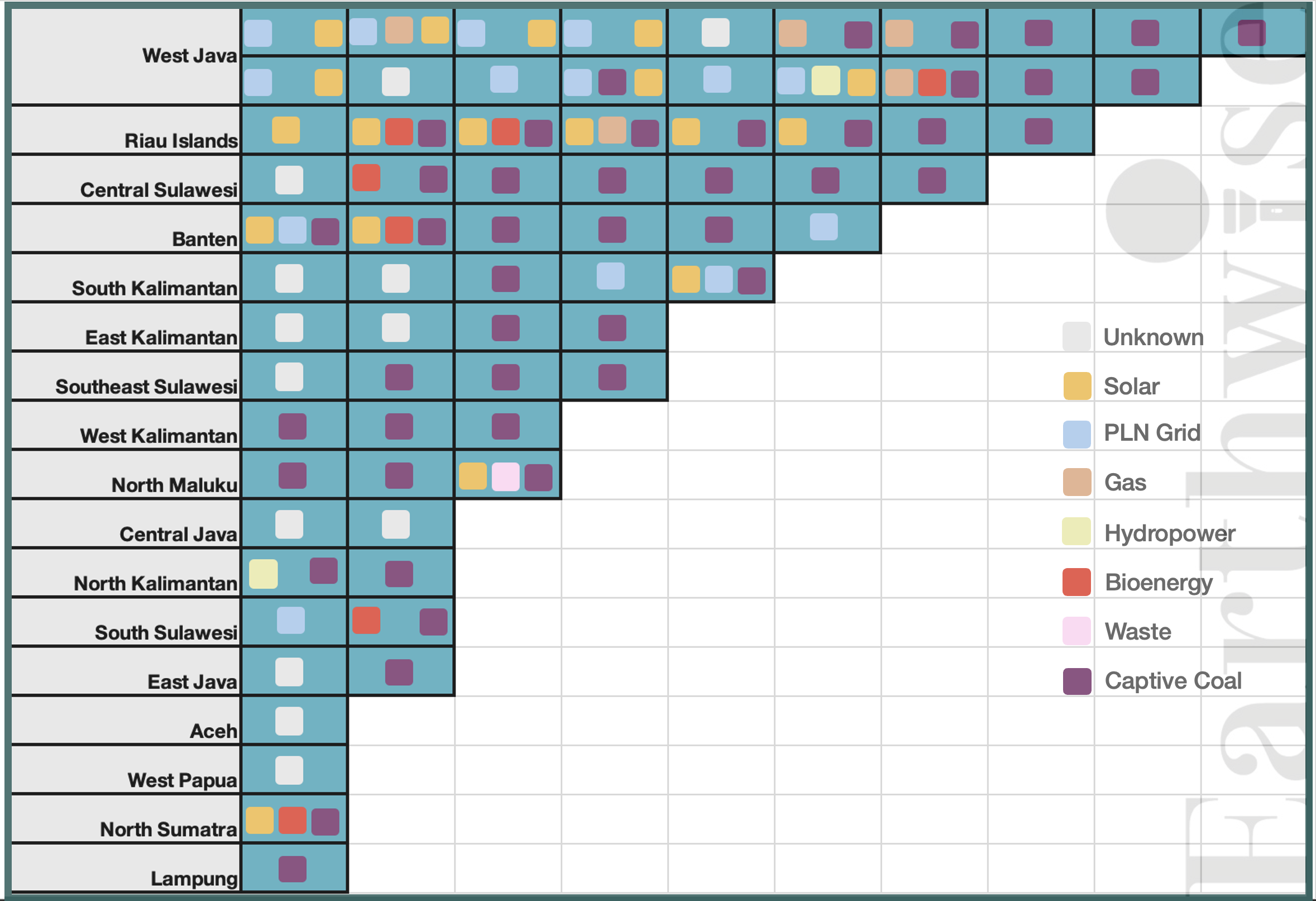
Right before Earth Day, we are pleased to share our latest study on Indonesia’s renewable energy (RE) landscape. It covers utility-scale RE, industrial captive RE, and the financing behind them.
Indonesia is the world’s ninth-largest energy-related CO₂ emitter. Emissions have more than doubled since 2000 due to heavy coal use. In February, we shared our analysis on captive coal projects and their financing in Indonesia. Together with this new RE research, it offers a clearer picture of the country’s energy transition.
This release features an Indonesia Renewables Database (you can access the full dataset here), which includes:
- Renewable Projects
- Captive Renewable Projects
- Owner and Geographical Profile
- Financing Transactions & Financier Profile
Here are some key insights:
- Gap between targets and reality: Indonesia could reach 35% renewable power by 2035. However, in major nickel-producing regions, coal is still expected to supply 83% - 94% of power. These areas lack local renewable resources. Long-distance transmission and storage may become feasible if transmission grid and energy storage infrastructure catches up, but not in the near term.
- Delivery gap in RE projects: Many mega-scale projects are announced, but few are delivered. Barriers include limited financing, policy uncertainty, loss of green premium, and technical challenges. Successful commissioning of mega renewable projects remains limited.
- Shift in financing trends: More RE deals are now backed by sovereign or policy support. Billion-dollar transactions are increasing. At the same time, green finance tools are used less often since 2023, as standards tighten and pricing advantages decline.
- Case study - PT ENC solar project: The 200MW project shows a workable model. Key factors include a strategic buyer willing to pay a green premium, an operating lease structure to reduce upfront costs, and strong policy support such as tax holidays.
- A comparative case study analysis: we also examined four cases from Indonesia, South Africa, Zimbabwe, and the DRC to compare how green power financing is being structured for heavy industry in emerging markets and developing economies (EMDEs).
This is the 3rd and final release of Earthwise Institute’s Indonesia Power Summary. The complete project can be found HERE.
Data-derived Insights:
Where to Start: Prioritising Captive Renewable Energy Pilots in Indonesia’s Industrial Parks
Captive Renewables Remain Structurally Marginal: 94% of Nickel linked and 77% of Aluminium linked Captive Power in Indonesia Still Supplied by Coal
Indonesia’s Industrial Power System Remains Coal-Anchored Despite Growing Energy Diversity
Indonesia’s Renewable Pipeline Is Failing to Materialise: Structural Barriers, Not Lack of Ambition, Underlie the Captive and On-Grid Delivery Gap
35% Renewables by 2035 – Indonesia’s System Expansion Without Industrial Decarbonisation
Indonesia’s Renewable Market: Mega-Deal Financing Rises and Green Premium Fades
Comparative Case Study Analysis: How Green Power Financing Is Structured in EMDE Heavy Industry
Case Study – PT ENC 200MW Solar Project Financing
Indonesia’s Aluminium Pipeline Reveals a Structural Power Gap of at Least 4 GW
Indonesia’s Nickel Sector Is Becoming Asset-Anchored, While Its EV Downstream Is Diverging from Coal Based Power Pathways
Previous Highlight Outputs:

The only official website of Earthwise Institute is https://earthwise.institute/
Any other website, domain, or online presence claiming to represent Earthwise Institute, including https://earthwiseinstitute.org/
, is unauthorized and not affiliated with us.
Earthwise Institute is not responsible for any content, communications, requests, or representations made through unauthorized sites.
Copyright © 2026. Earthwise Institute All Rights Reserved.