
Ironmaking Asset Transition Timelines
Mapping the lifecycles of ironmaking assets, especially conventional blast furnaces, to identify the most practical timing for green upgrade, replacement, and phase-out.
Understanding the transition windows of ironmaking assets is critical for assessing when meaningful shifts toward lower-carbon production can occur, yet in China, home to the world’s largest ironmaking fleet, there is limited public visibility into the status, ownership, age, replacement pathway, and future transition timing of individual units. This project provides a structured assessment of mainland China’s ironmaking sector, covering units with recorded operations between January 2017 and May 2026.
The analysis is built on an in-house, manually compiled unit-level database covering 1,324 ironmaking units with approximately 1,391 mmtpa (million metric tonnes per annum) of capacity. The database brings together information on unit status, capacity, furnace type, corporate affiliation, location, capacity replacement participation, major technology applications, and recorded construction, overhaul, and phase-out events. It provides the evidence base for all findings presented in this research series.
The project presents a forward-looking assessment of transition windows across China’s conventional blast furnace fleet. This analysis identifies when individual furnaces are likely to reach their next major relining or reinvestment decision point, creating potential windows for life extension, replacement, phase-out, or lower-carbon upgrading.
Supporting analyses examine the structure and geographic distribution of the current fleet, capacity replacement implementation, regional and corporate patterns, financial pressure, and the deployment of green ironmaking technologies. Together, the project provides a clearer picture of how China’s ironmaking fleet is changing, where major transition decisions are likely to emerge, and how far lower-carbon technology deployment has progressed.
Main findings of the project include:
China’s Ironmaking Fleet
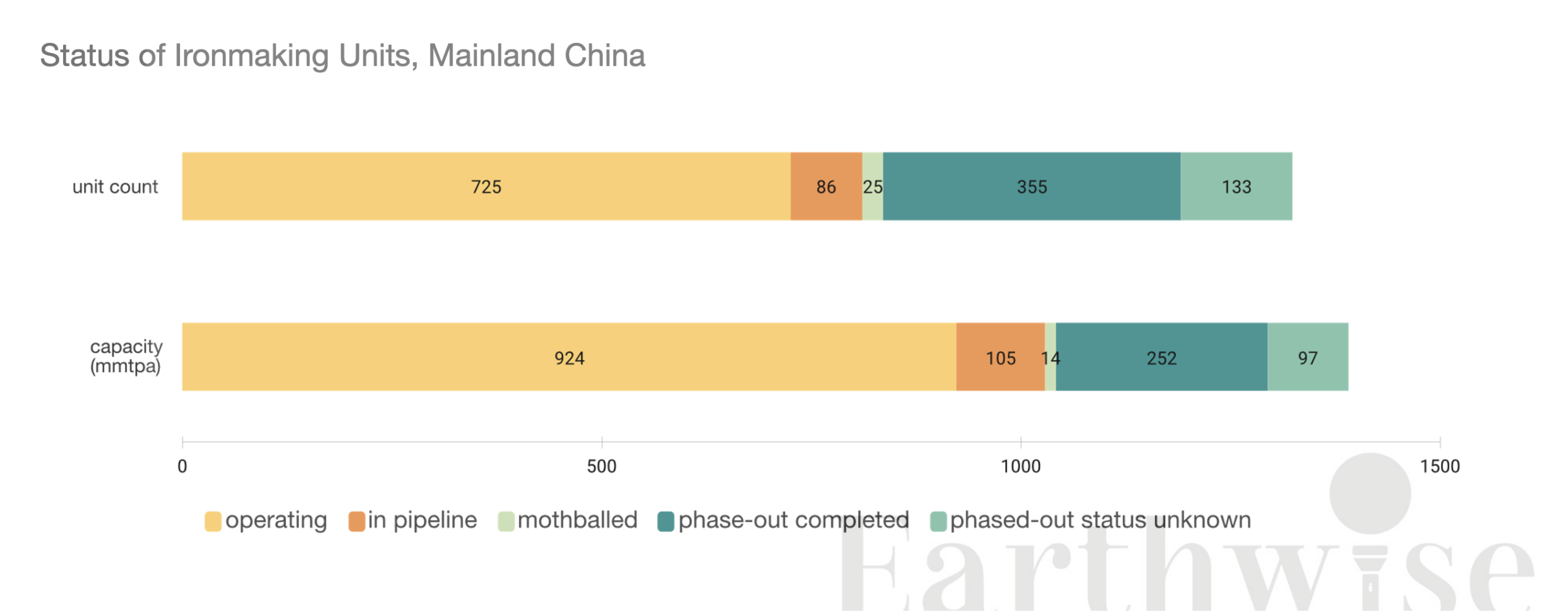
*Remarks: “Operating” in this figure includes operating units as well as units that are currently under overhaul and will resume operation right after the completion of overhaul. “In pipeline” in this figure includes units that are in status of announced, pre-construction as well as under construction.
Earthwise Institute tracked ironmaking units in mainland China that had recorded operations between January 2017 and May 2026. The dataset covers 1,324 units with a total capacity of approximately 1,391 mmtpa. As of May 2026, 725 units with 923.65 mmtpa were operating, including 17 units under overhaul with 32.09 mmtpa that are expected to resume operation after completion.
Around two-thirds of the capacity tracked by Earthwise Institute remained operating, or was under overhaul and expected to return to operation. Phase-out has covered a substantial volume of historical ironmaking assets since 2017. Phased-out or planned phase-out units account for around 37% of all units but only around 25% of total capacity, indicating the retirements being concentrated among smaller units. Pipeline capacity should mainly be understood as asset renewal, consolidation, and replacement. Under China’s capacity replacement framework introduced in 2017, new ironmaking capacity is generally expected to correspond to the retirement of older capacity, keeping total national capacity broadly stable or lower.
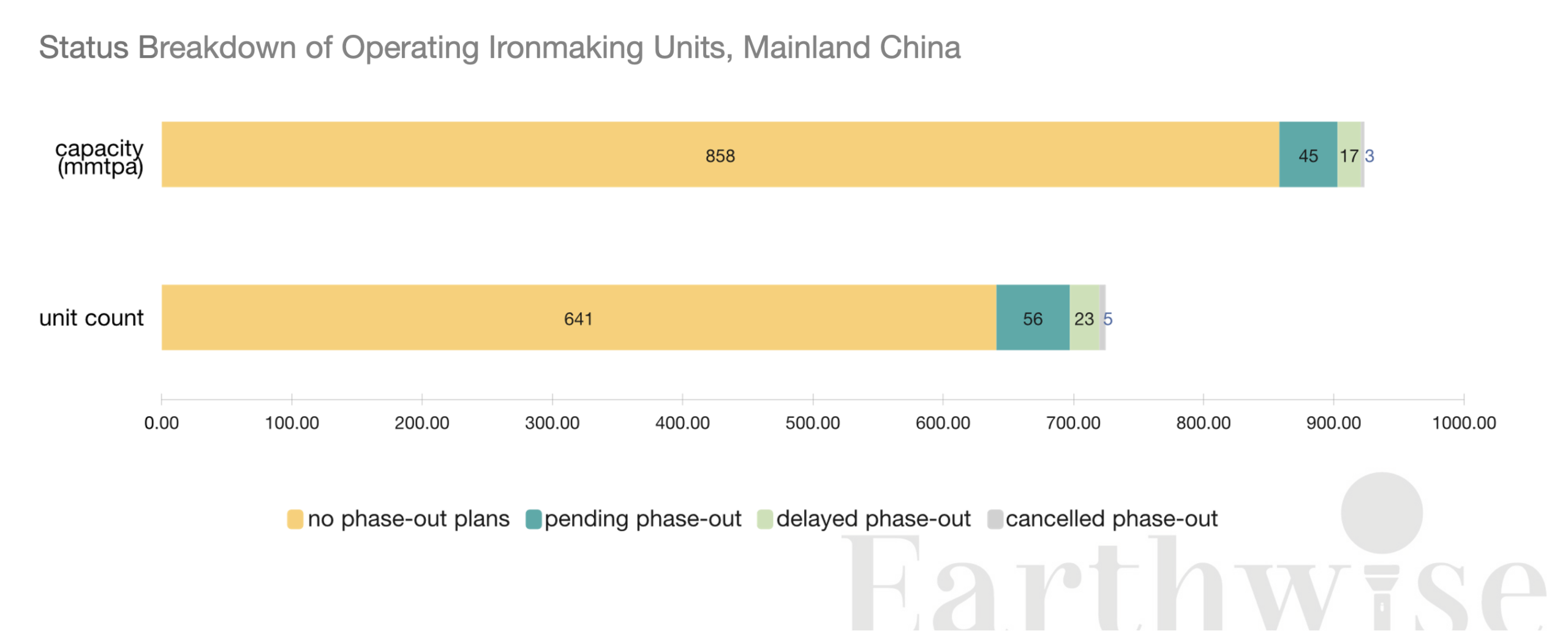
*Remarks: “Operating” in this figure includes operating units as well as units that are currently under overhaul and will resume operation right after the completion of overhaul.
93.2% of operating ironmaking capacity comes from units commissioned after the implementation of the capacity replacement scheme, therefore having no pending phase-out arrangement. A further 63.28 mmtpa remains in operation despite an identified phase-out pathway, including capacity classified as pending phase-out or delayed phase-out. This is lower than total in-pipeline capacity, partly because some announced projects do not yet have publicly disclosed replacement relationships or cannot be matched with specific retiring assets, including several early-stage hydrogen and other green ironmaking projects.
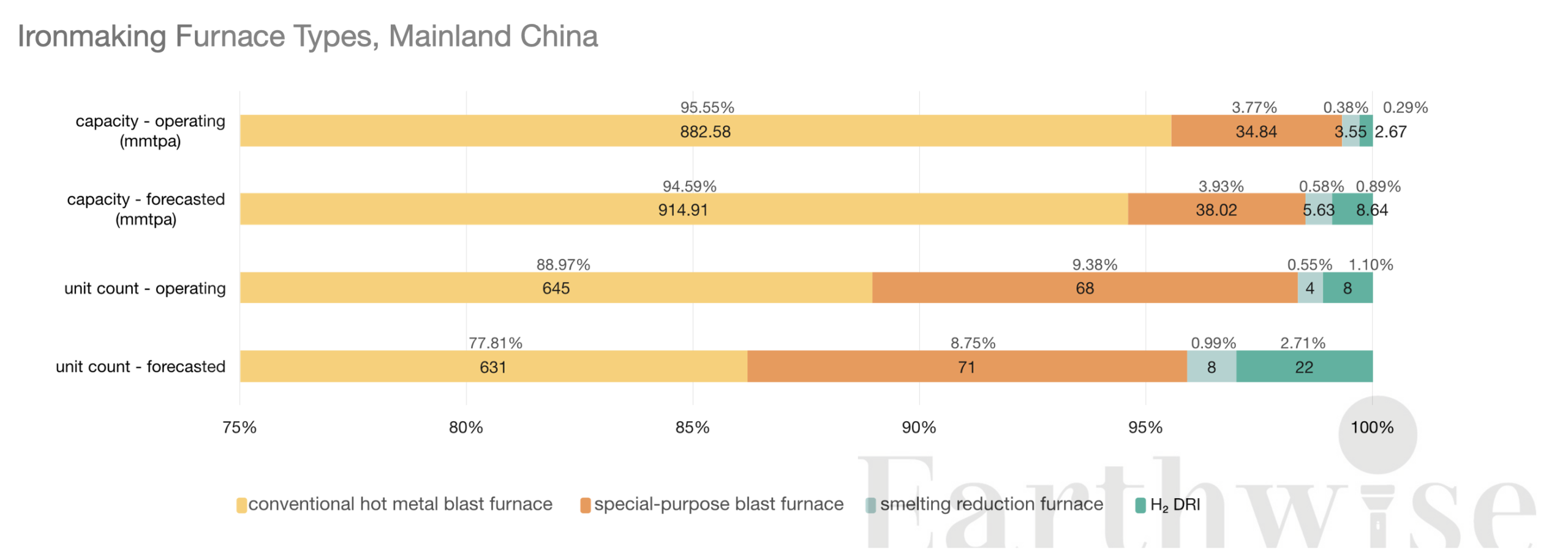
*Remarks: the category of “special-purpose blast furnace” includes furnace types of: foundry pig iron blast furnace, ferromanganese blast furnace, manganese rich slag blast furnace, nickel chromium pig iron blast furnace, VTM blast furnace and NPI blast furnace. The category “H₂ DRI” includes furnace types of: H₂ DRI fluidized bed, H₂ DRI rotary hearth furnace, H₂ DRI rotary kiln and H₂ DRI shaft furnace.
*Remarks II: “Forecasted” refers to a scenario in which all pipeline and under-construction units reach commissioning, while all pending and delayed phase-out units complete their phase-out process. As some pipeline projects, including a number of hydrogen-based or other green ironmaking projects, have been announced without publicly identified corresponding replacement phase-out units, the actual future breakdown of furnace types may vary slightly from this scenario.
China’s operating ironmaking fleet remains overwhelmingly based on blast furnace technology. Conventional hot metal blast furnaces and special-purpose blast furnaces together account for more than 99% of operating capacity, while smelting reduction and H₂ DRI routes account for less than 1%. Under the forecasted scenario, smelting reduction capacity would rise to 5.63 mmtpa and H₂ DRI capacity to 8.64 mmtpa, increasing the number of green alternative units from 12 to 30; however, these technologies would still account for only around 1.5% of total capacity, leaving conventional blast furnaces dominant.
**Read the general analyses on China’s ironmaking fleet:
China’s Ironmaking Fleet: Status, Structure and Capacity Replacement
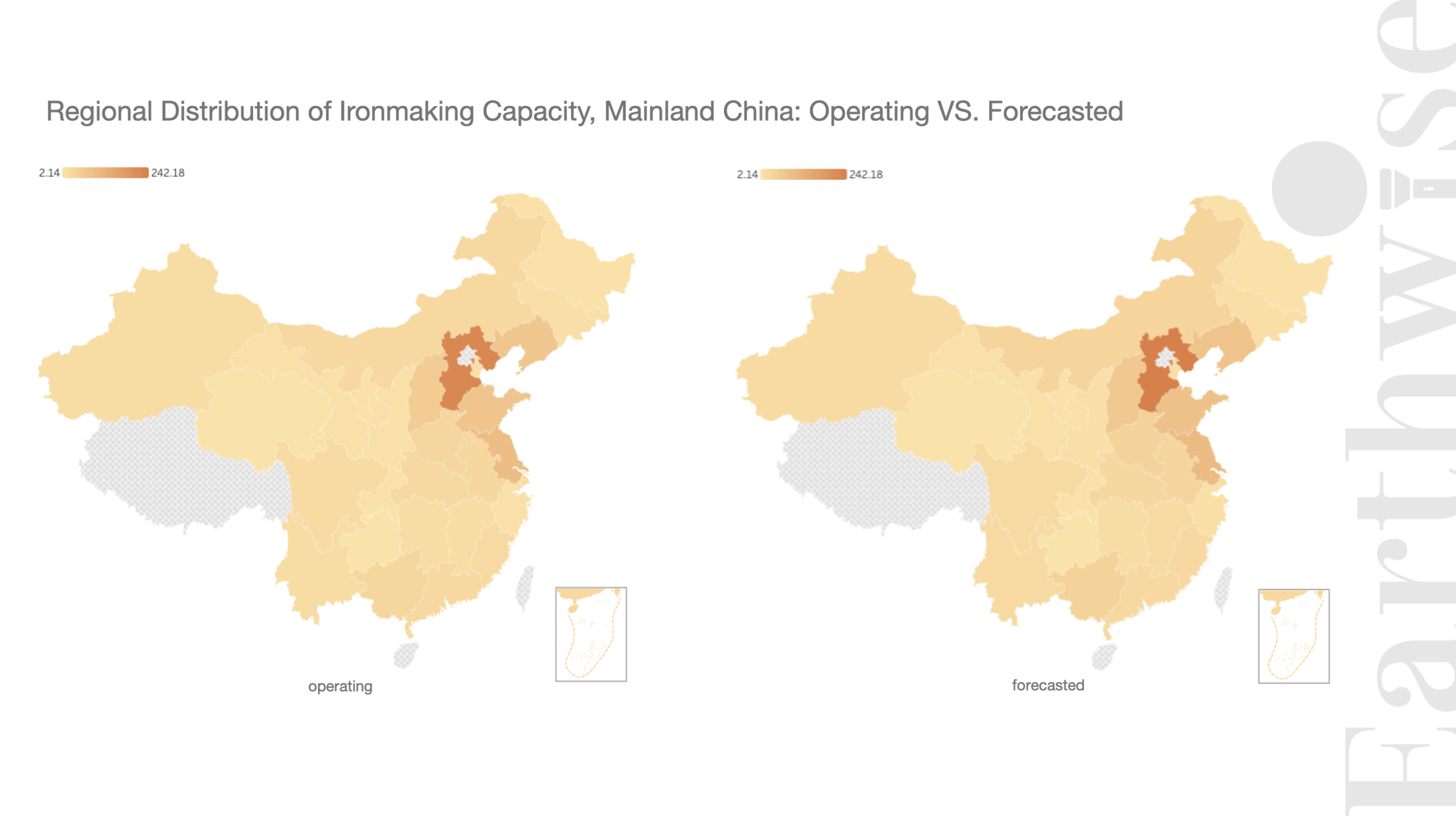
Ironmaking capacity in China is highly concentrated in Hebei and surrounding provinces. Hebei is the largest provincial ironmaking capacity holder, accounting for 24.4% of current operating capacity. Together, Hebei, Jiangsu, Shandong, Liaoning, and Shanxi account for 56.7% of operating capacity, showing that ironmaking assets remain concentrated in established steel-producing regions in northern and eastern coastal China. Even if all identified pipeline projects are commissioned and pending phase-outs are completed, this regional structure remains broadly stable.
**Read the full regional analysis of China’s ironmaking fleet:
China’s Regional Ironmaking Transition: Capacity Replacement, Phase-outs and Newbuilds
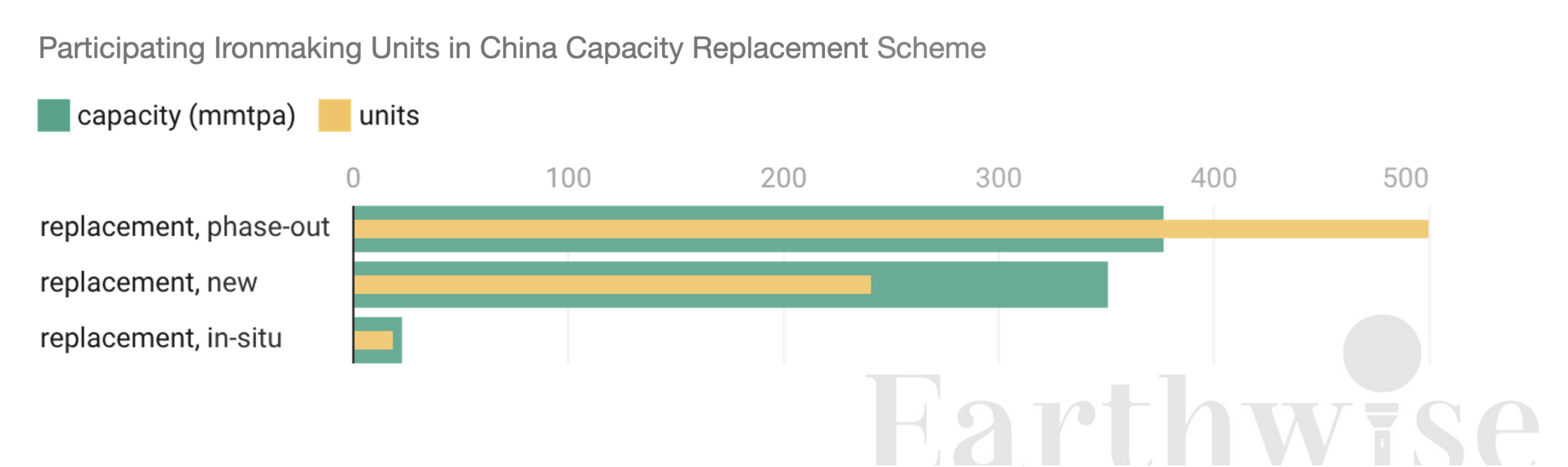
As of 17 May 2026, Earthwise Institute identified 760 ironmaking units participating in China’s capacity replacement scheme, involving 751.48 mmtpa of capacity. This includes 500 phase-out units with 377.23 mmtpa, 241 replacement newbuild units with 350.94 mmtpa, and 19 in-situ replacement units with 23.31 mmtpa. The replacement process has also increased average furnace scale, newbuild furnaces were therefore 1.94 times larger on average: phased-out units average 0.75 mmtpa, compared with 1.46 mmtpa for replacement newbuild units. The identified phase-out-to-newbuild capacity ratio is 1.07:1, close to the minimum replacement requirement for non-key regions under China’s capacity replacement rules.
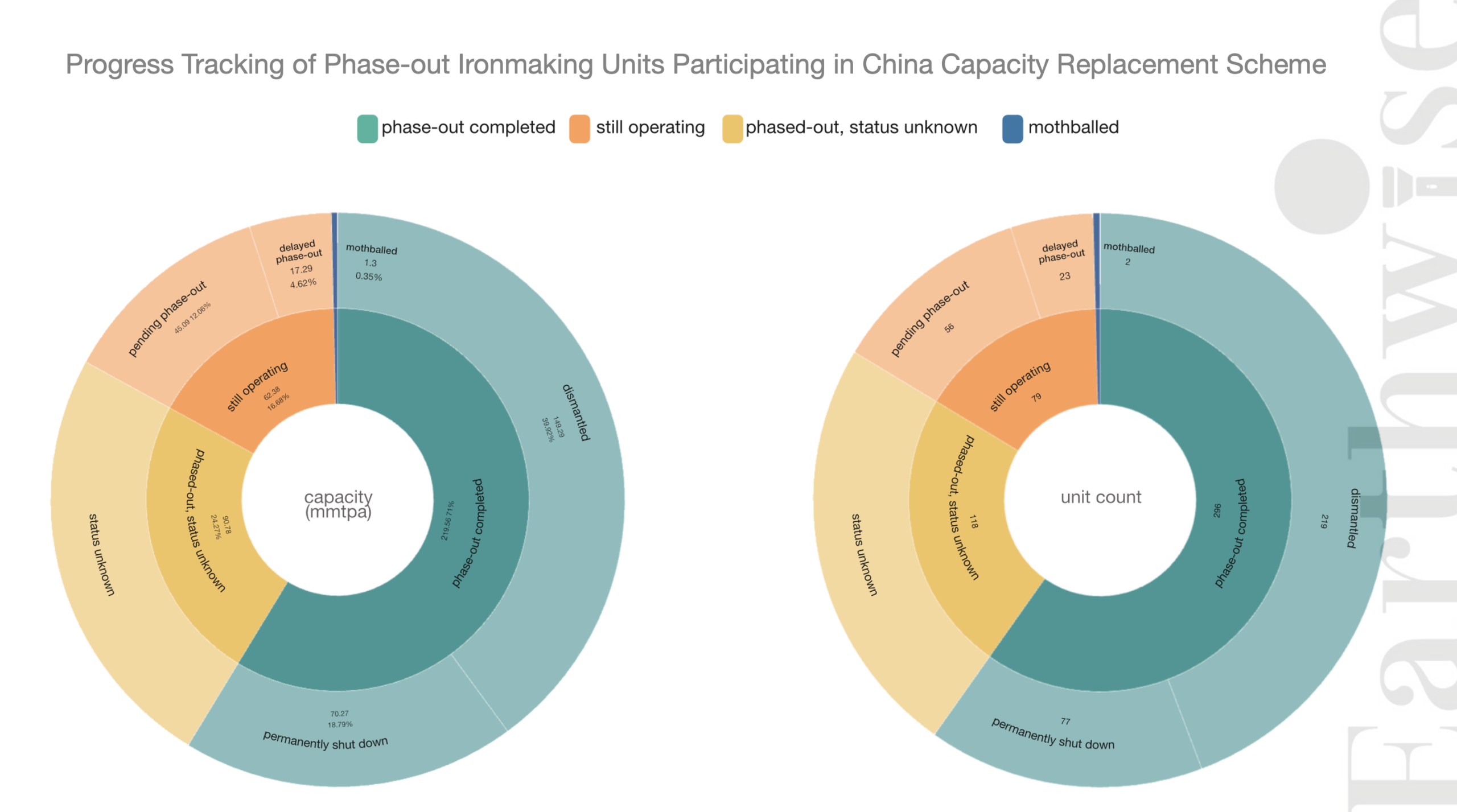
Inclusion in a replacement phase-out plan does not necessarily mean that capacity has already exited operation. Around 59% of phase-out capacity has been confirmed as retired, with more than two-thirds of this completed capacity dismantled and the remainder permanently shut down. At the same time, around 17% remains in operation, mainly under pending or delayed phase-out status, while a further 24% has reached its planned phase-out timing but has no confirmed final status. The results show both the practical time lag between replacement announcements and asset retirement, and a continuing public-information gap on final closure or demolition outcomes.
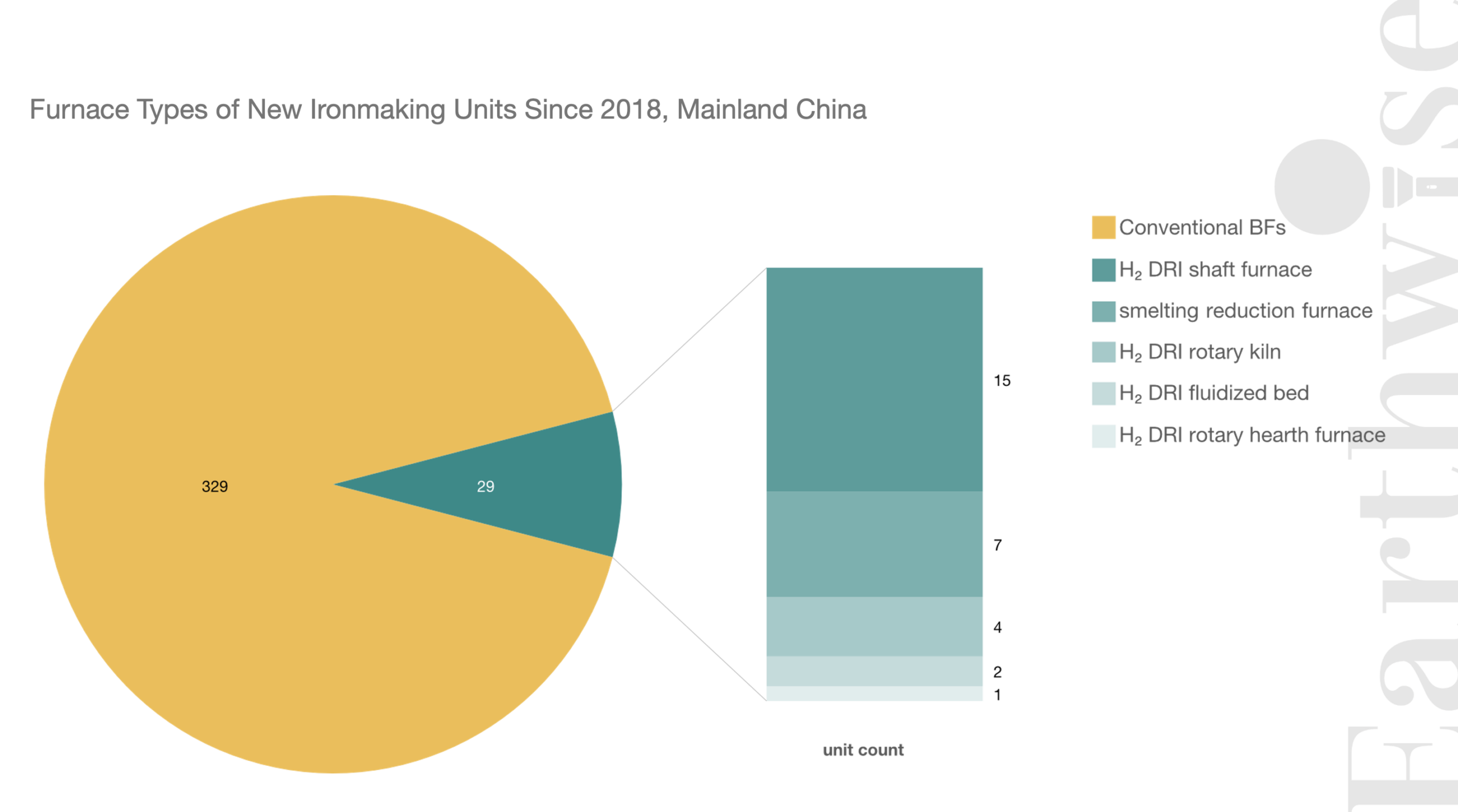
New ironmaking capacity commissioned since 2018 has remained overwhelmingly conventional. Of 358 identified new units, 329 are conventional blast furnaces, accounting for around 97% of new capacity. H₂ DRI and smelting reduction furnaces together account for 29 units and less than 3% of new capacity. Alternative technologies have therefore begun to enter the project pipeline, but capacity replacement has primarily renewed, consolidated, and upscaled the conventional blast furnace system rather than shifted its underlying technology structure.
**Read the full analysis on China's progress in Capacity Replacement Scheme:
China’s Ironmaking Capacity Replacement: Progress, Technology and Remaining Phase-out
Corporate Landscape
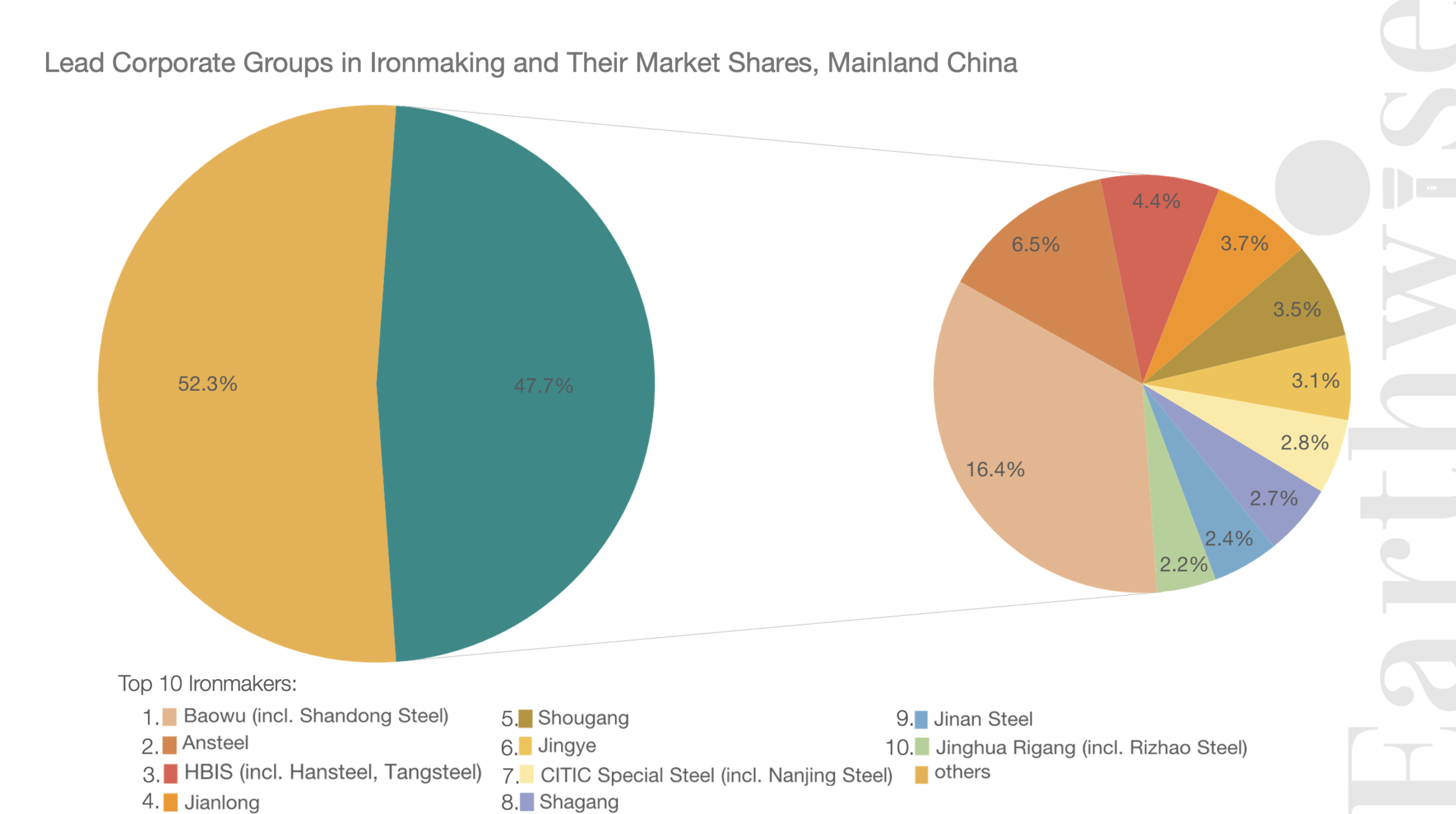
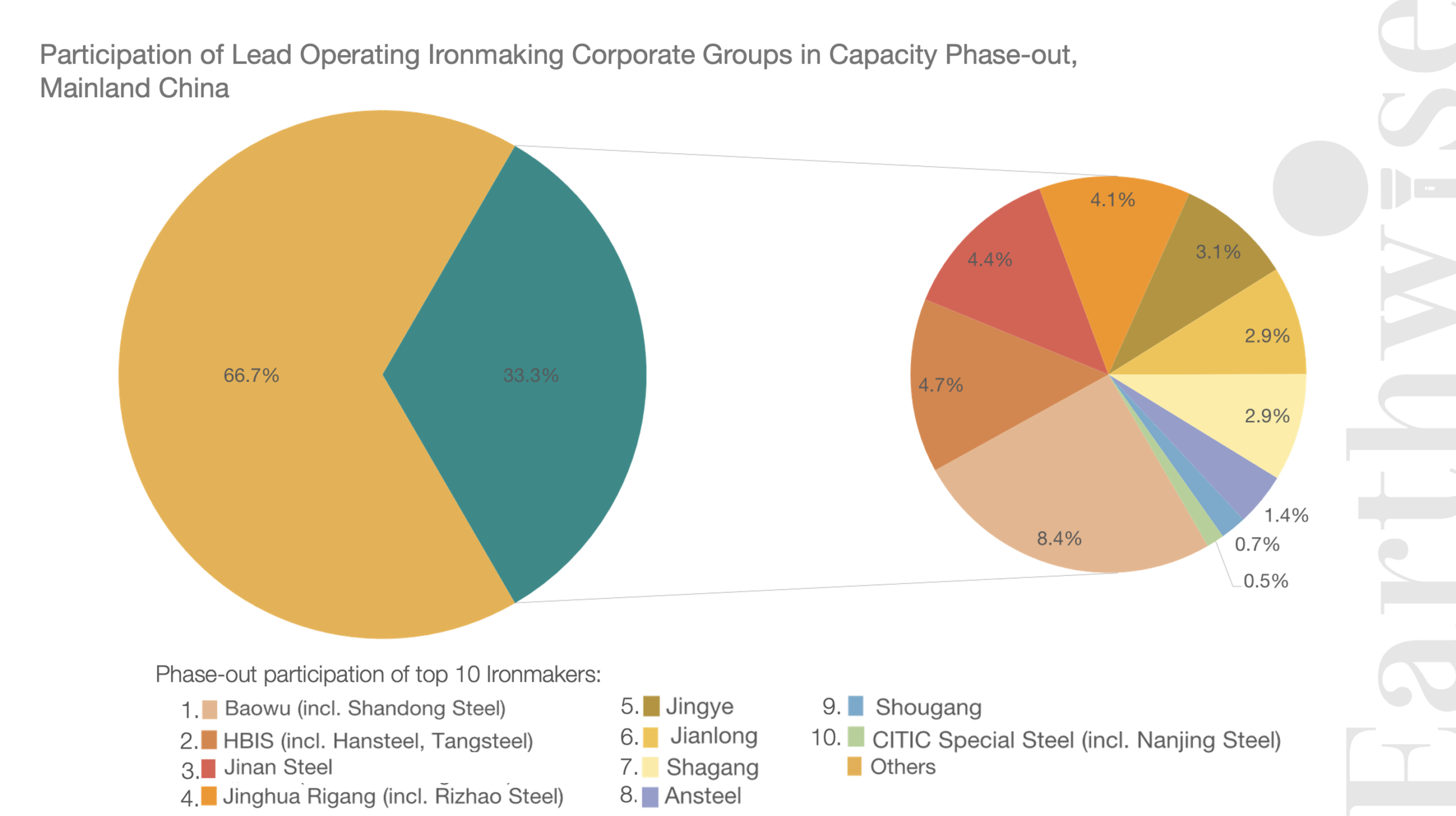
China’s ironmaking fleet remains only moderately concentrated: the ten largest corporate groups account for 47.7% of operating capacity, while more than half is distributed across over 150 other groups and companies. This fragmented structure is even more pronounced in capacity replacement phase-out. Companies outside the top ten account for 52.3% of operating capacity but 66.7% of identified phase-out capacity, indicating that retirement and facility exit are weighted more heavily toward the industry tail, while the largest groups retain a comparatively more stable capacity base.
**Read the full analysis on Corporate Landscape:
China’s Ironmaking Corporate Landscape: Concentration, Capacity Replacement and Phase-out
Transition Windows
Earthwise Institute estimates the next major transition window for each conventional blast furnace as an indicative point at which operators may face a significant reinvestment decision. These windows do not predict closure or technology adoption; rather, they indicate when an asset may be more likely to require relining, life extension, replacement, phase-out, or a lower-carbon upgrade.
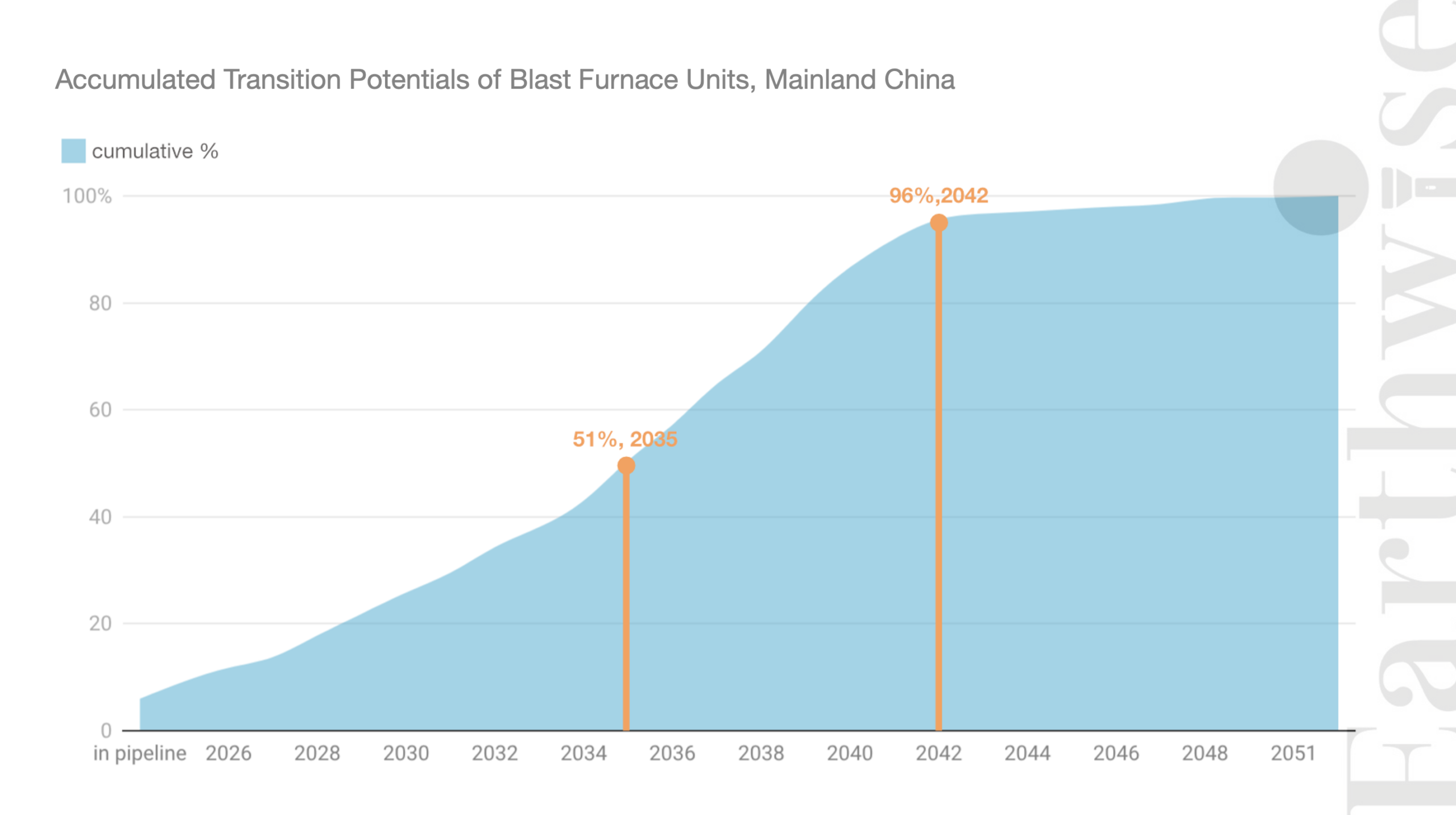
Under an idealised scenario, around 51% of conventional blast furnace capacity will reach its next major relining or reinvestment window by 2035, while 96% will do so by 2042. The fastest release of transition potential occurs between 2035 and 2042, when the cumulative share rises by 45%.
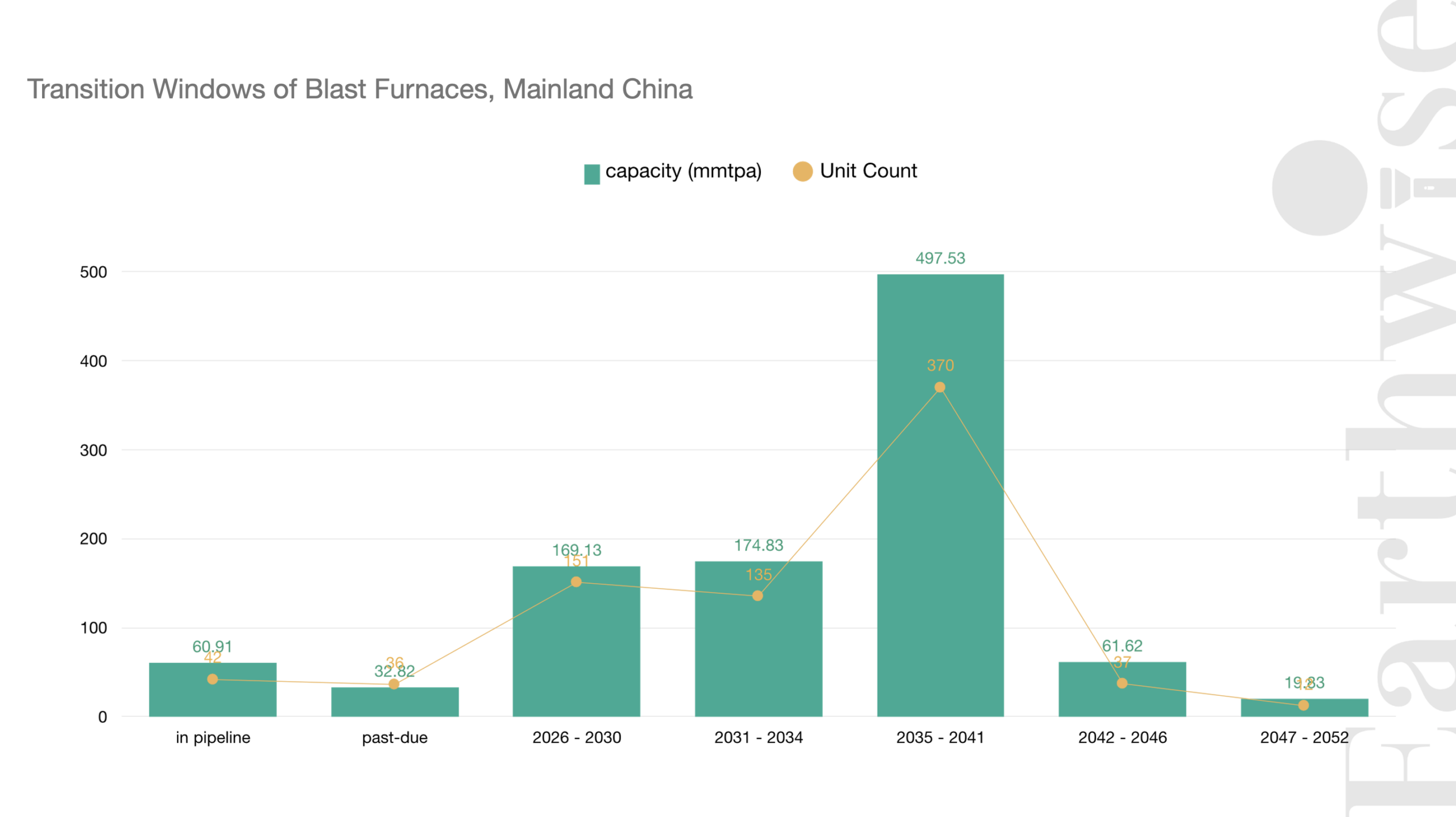
The most concentrated transition period runs from 2035 to 2041, when 48.94% of national conventional blast furnace capacity is expected to reach the next major relining or reinvestment window. The peak occurs in 2039, when 70 units with 86.05 mmtpa of capacity are expected to reach their next transition window.
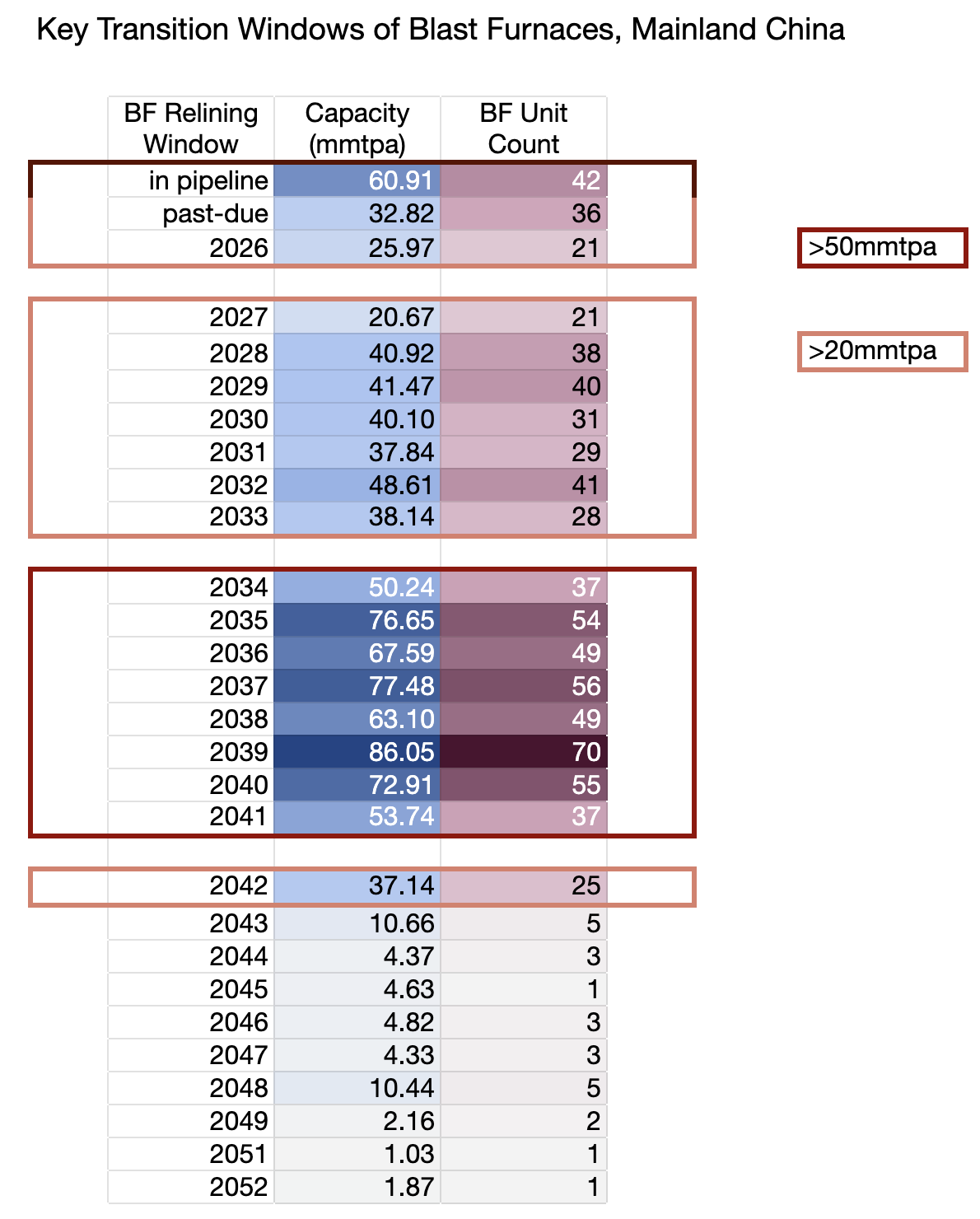
Using 50 mmtpa of annual capacity as a high-intensity threshold, 2034-2041 forms the broadest concentrated transition period, while 2027-2033 and 2042 also represent important years for major reinvestment decisions. A total of 99 units with 119.80 mmtpa of capacity are already within, or have reached, their estimated transition window, including pipeline units and assets whose expected relining window has already passed or falls in 2026. These units form the most immediate group for verifying actual relining, life-extension, lower-carbon upgrade, replacement, or phase-out plans.
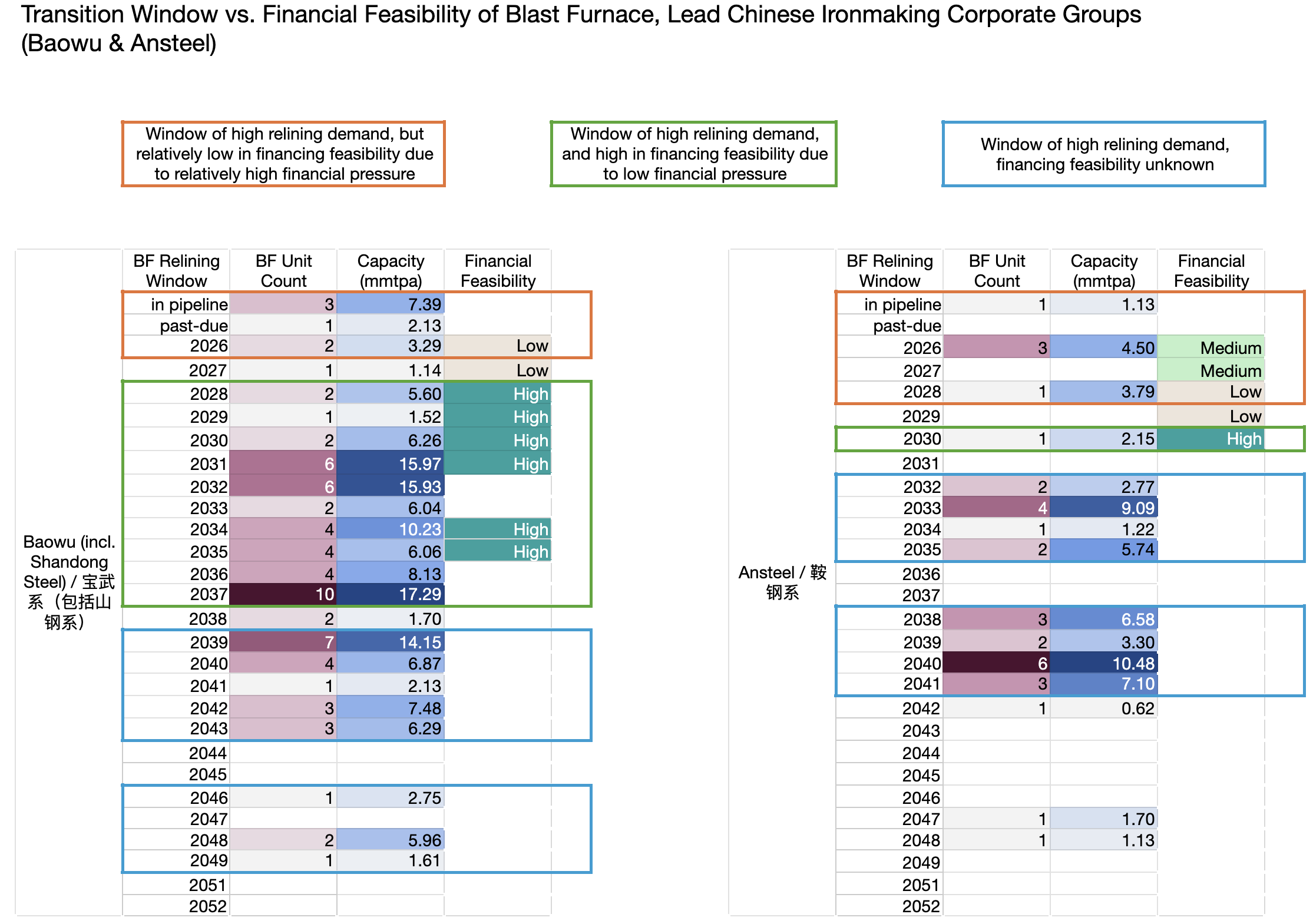
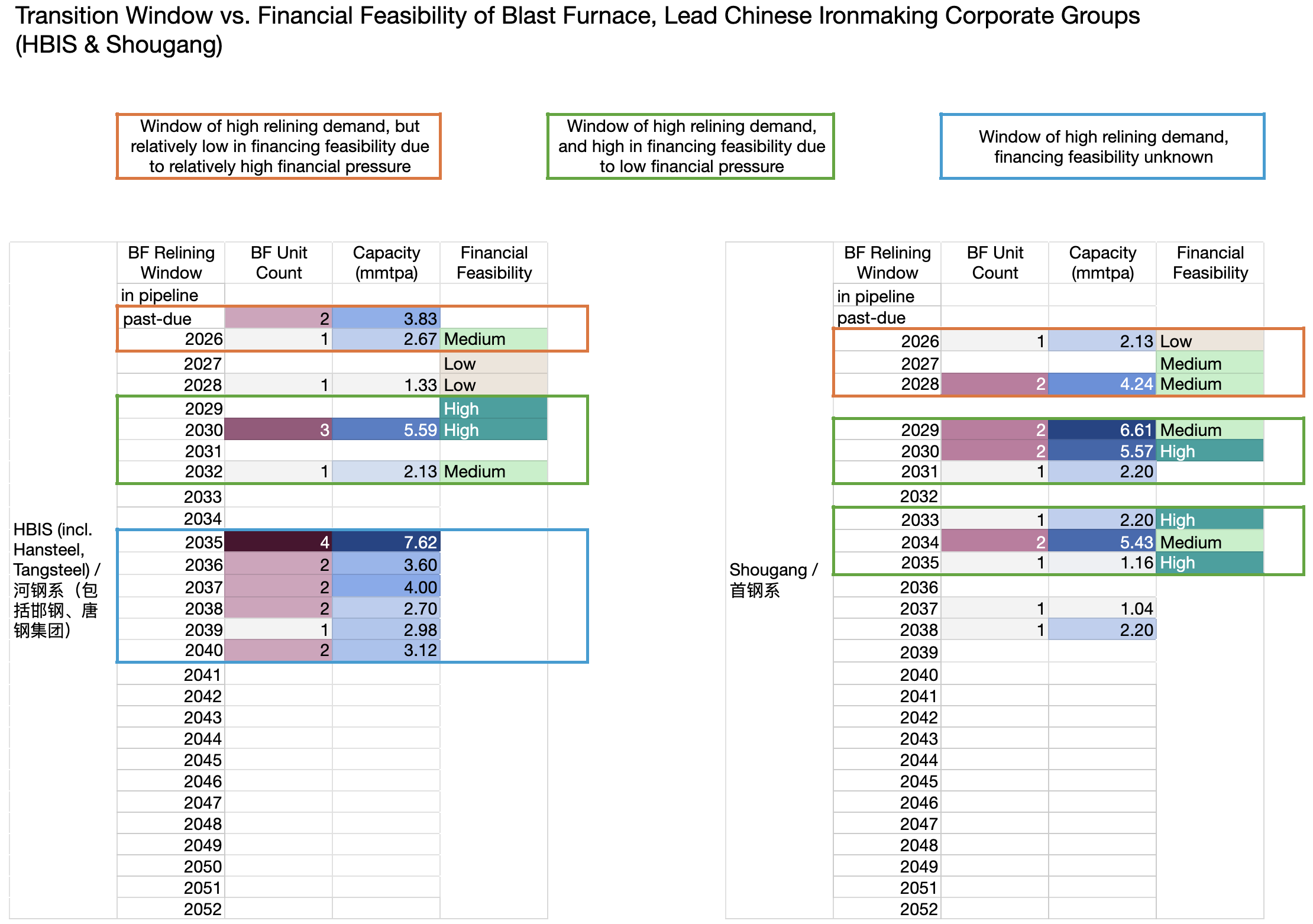
The tables below provide a group-level mapping of the estimated transition windows of conventional blast furnaces across mainland China’s ironmaking sector. They allow users to identify the timing, scale, and concentration of transition demand by corporate group, ranked either by blast furnace unit count or by ironmaking capacity.
Table: Transition Window of Blast Furnace for every Corporate Group in Ironmaking, Mainland China, Ranked by Blast Furnace Unit Count


Table: Transition Window of Blast Furnace for every Corporate Group in Ironmaking, Mainland China, Ranked by Ironmaking Capacity


The project also applies a preliminary financial-pressure overlay, mapping estimated transition years against company-level debt maturity profiles. This indicator provides a directional signal of whether major technical reinvestment needs may coincide with periods of relatively higher or lower refinancing pressure; it does not predict investment decisions, repayment outcomes, or project bankability.
**Read the full analysis on transition windows:
China’s Blast Furnace Transition Windows: Timing Green Upgrade and Phase-out Decisions
Green Ironmaking Techs
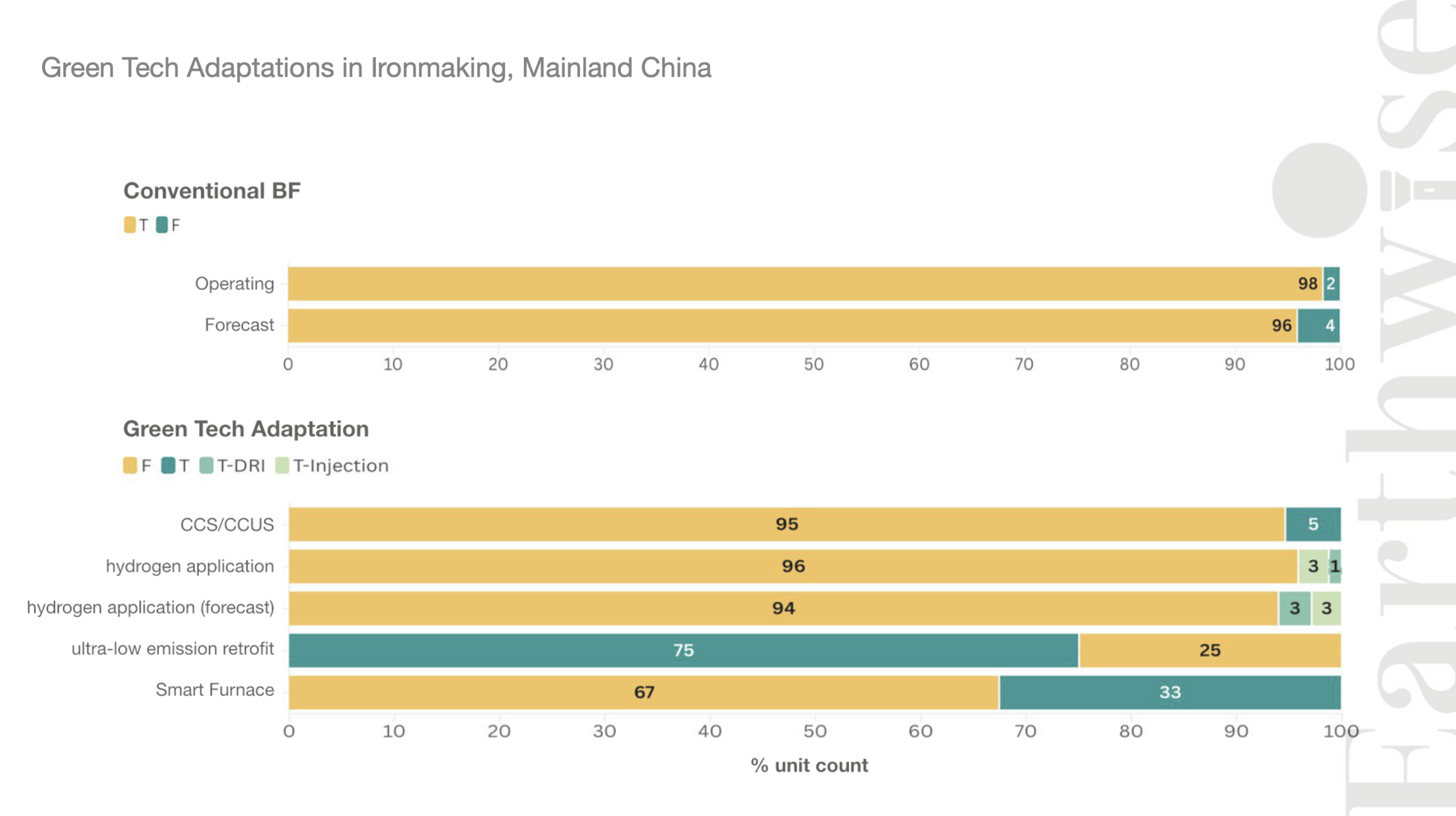
Environmental and operational upgrades are already widely deployed across China’s ironmaking fleet. TRT/BPRT is treated as a mature, standard energy-recovery technology, with reported coverage above 99% across blast furnaces. Ultra-low-emission retrofits cover around 75% of ironmaking units, while smart or intelligent blast furnace management is identified in around 33%. These upgrades can improve energy recovery, environmental performance, production control, and resource efficiency, but they do not directly replace the coal- and coke-based reduction process of conventional blast furnaces. By contrast, hydrogen applications and CCS/CCUS remain at an early stage, with hydrogen identified in around 4% of units, rising to around 6% in the forecasted scenario, and CCS/CCUS activity identified for around 5% of units or associated companies.
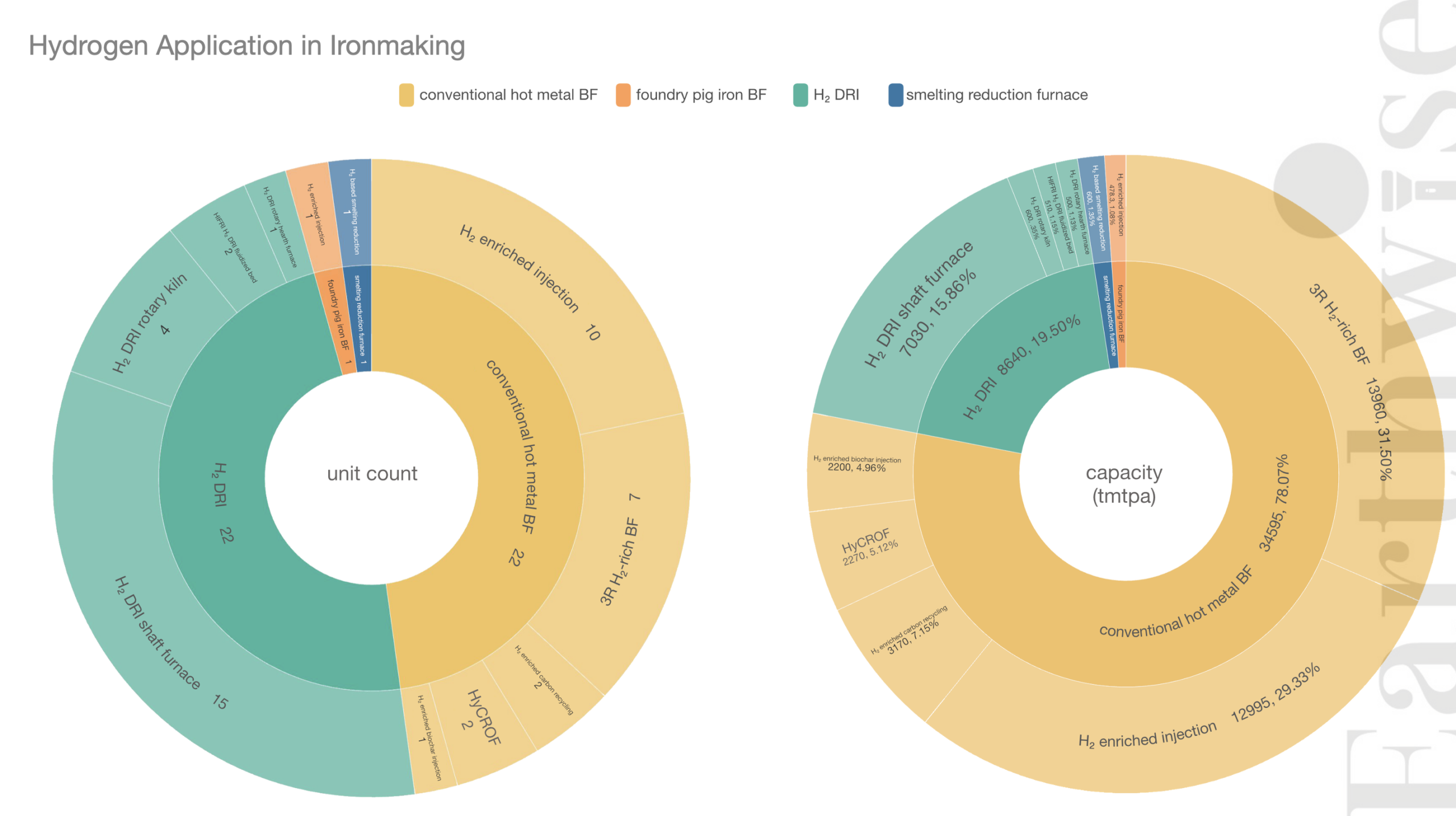
78% of associated capacity on current hydrogen ironmaking deployment is based on increasing hydrogen use within existing large blast furnaces through routes such as hydrogen-enriched injection, biochar injection, carbon recycling, HyCROF, and 3R. H₂ DRI has formed a growing project base, but many units remain pilots or early commercial projects. H₂ DRI units with a capacity bigger than 1,000 tmtpa are rare.
**Read the full analysis on green ironmaking techs:
China’s Green Ironmaking Transition: Technology Uptake and Emerging Alternatives
Insight Articles of this Project:
1. general analyses on China’s ironmaking fleet:
China’s Ironmaking Fleet: Status, Structure and Capacity Replacement
2. analysis on blast furnace transition windows:
China’s Blast Furnace Transition Windows: Timing Green Upgrade and Phase-out Decisions
3. analysis on China's progress in Capacity Replacement Scheme:
China’s Ironmaking Capacity Replacement: Progress, Technology and Remaining Phase-out
4. analysis on ironmaking corporate landscape:
China’s Ironmaking Corporate Landscape: Concentration, Capacity Replacement and Phase-out
5. regional analysis of China’s ironmaking fleet:
China’s Regional Ironmaking Transition: Capacity Replacement, Phase-outs and Newbuilds
6. analysis on China's green ironmaking techs applications:
China’s Green Ironmaking Transition: Technology Uptake and Emerging Alternatives
Methodology
Read the methodology of data collection:
Methodology - Ironmaking Assets Data Collection
Read the methodology of blast furnace transition window estimation & financial feasibility estimation:
Methodology - Estimating Blast Furnace Transition Windows
Visualisation Note: Some data visualisations presented in this project were produced using online visualisation platforms, including Flourish and Datawrapper. These platforms are used solely to support the presentation and accessibility of Earthwise Institute’s analysis. All underlying data, calculations, classifications, and interpretations are developed and maintained by Earthwise Institute.
Other Projects:
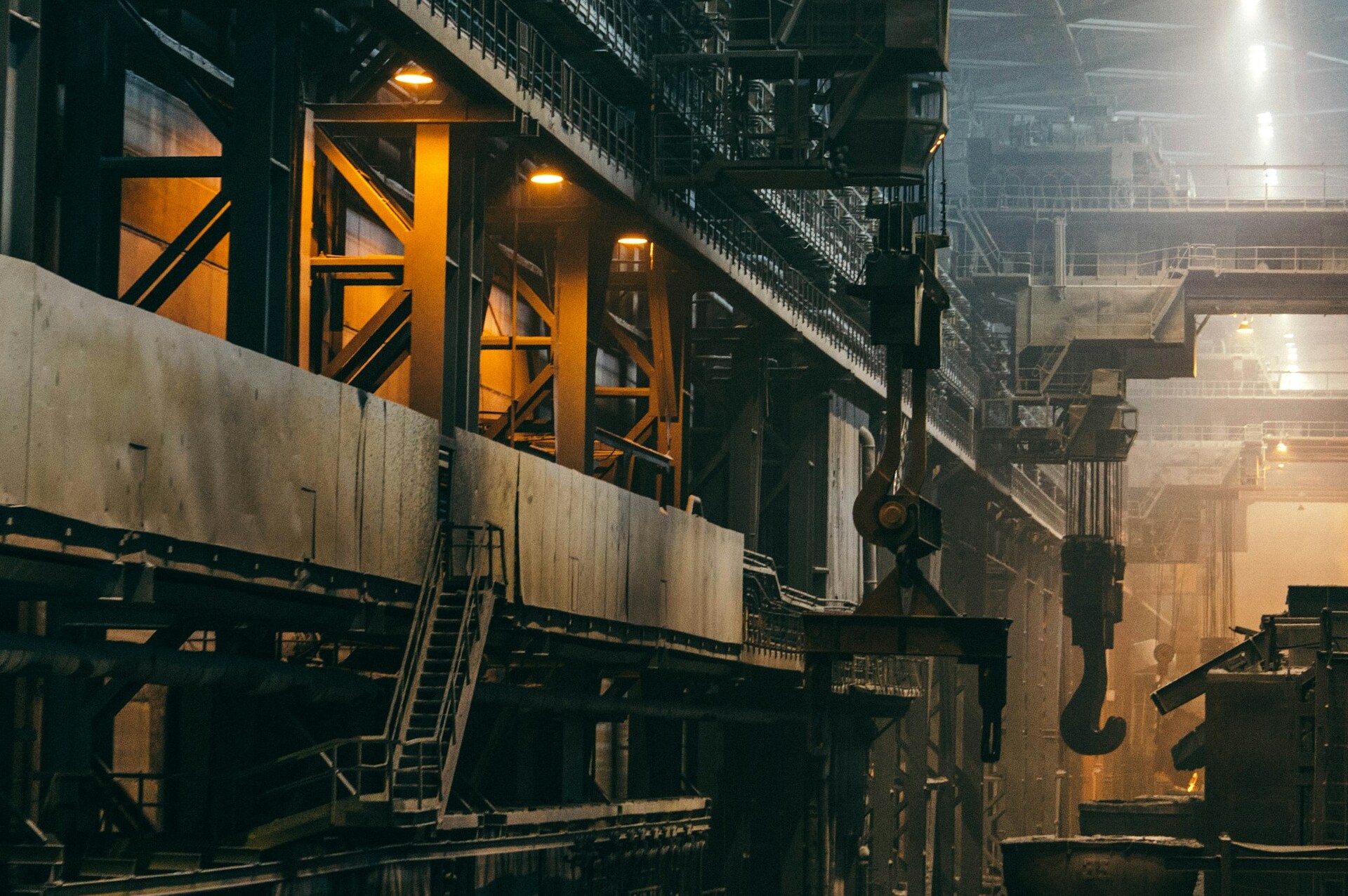
Core Industrial Development In Asia and the Middle East
Research on decarbonization pathways in metals, cement, petrochemicals, and large-scale manufacturing, with a focus on asset-level industrial systems.
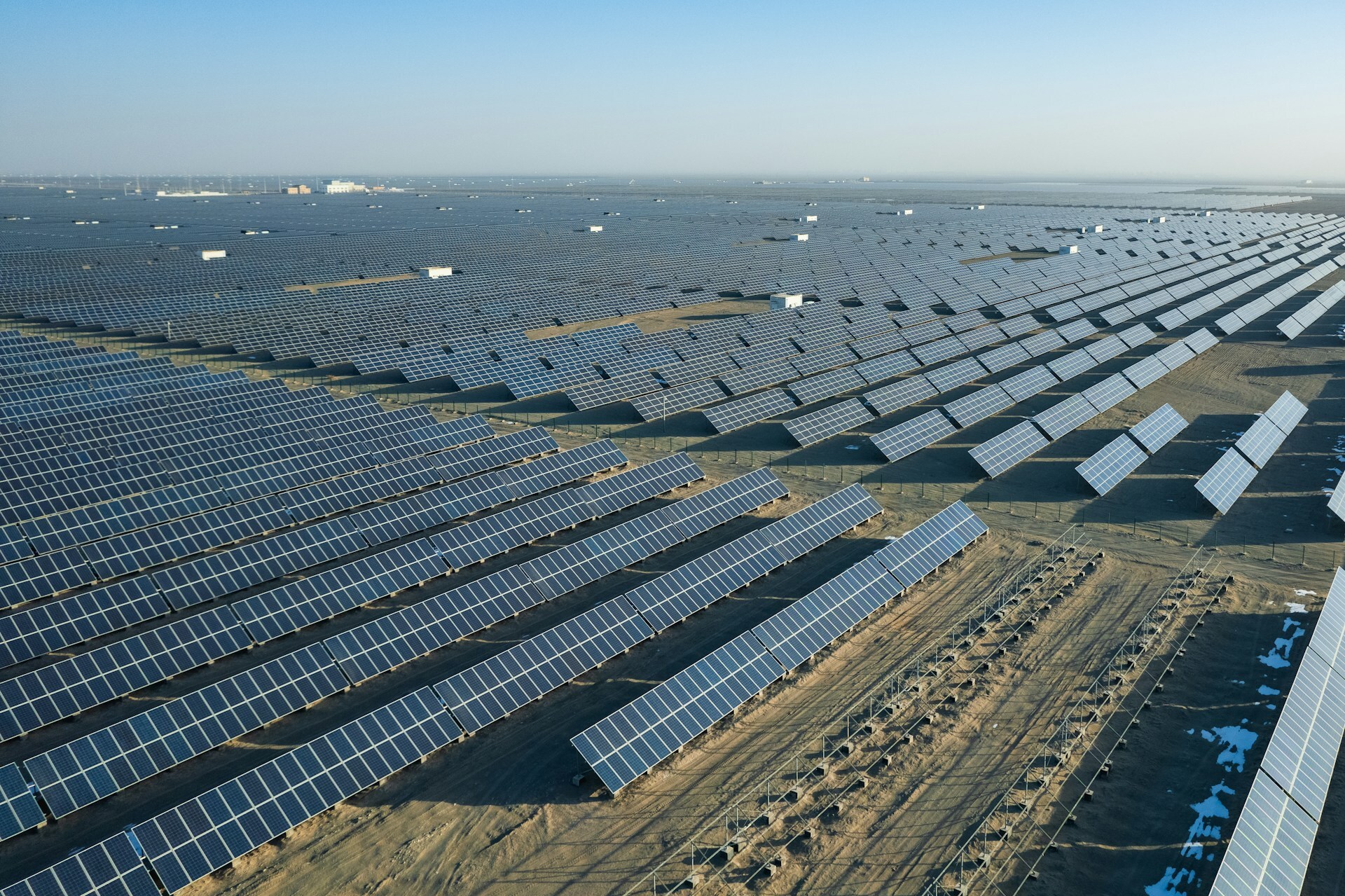
Climate Tech Lookbook
A structured research platform tracking and classifying climate-relevant technologies across major economic sectors.
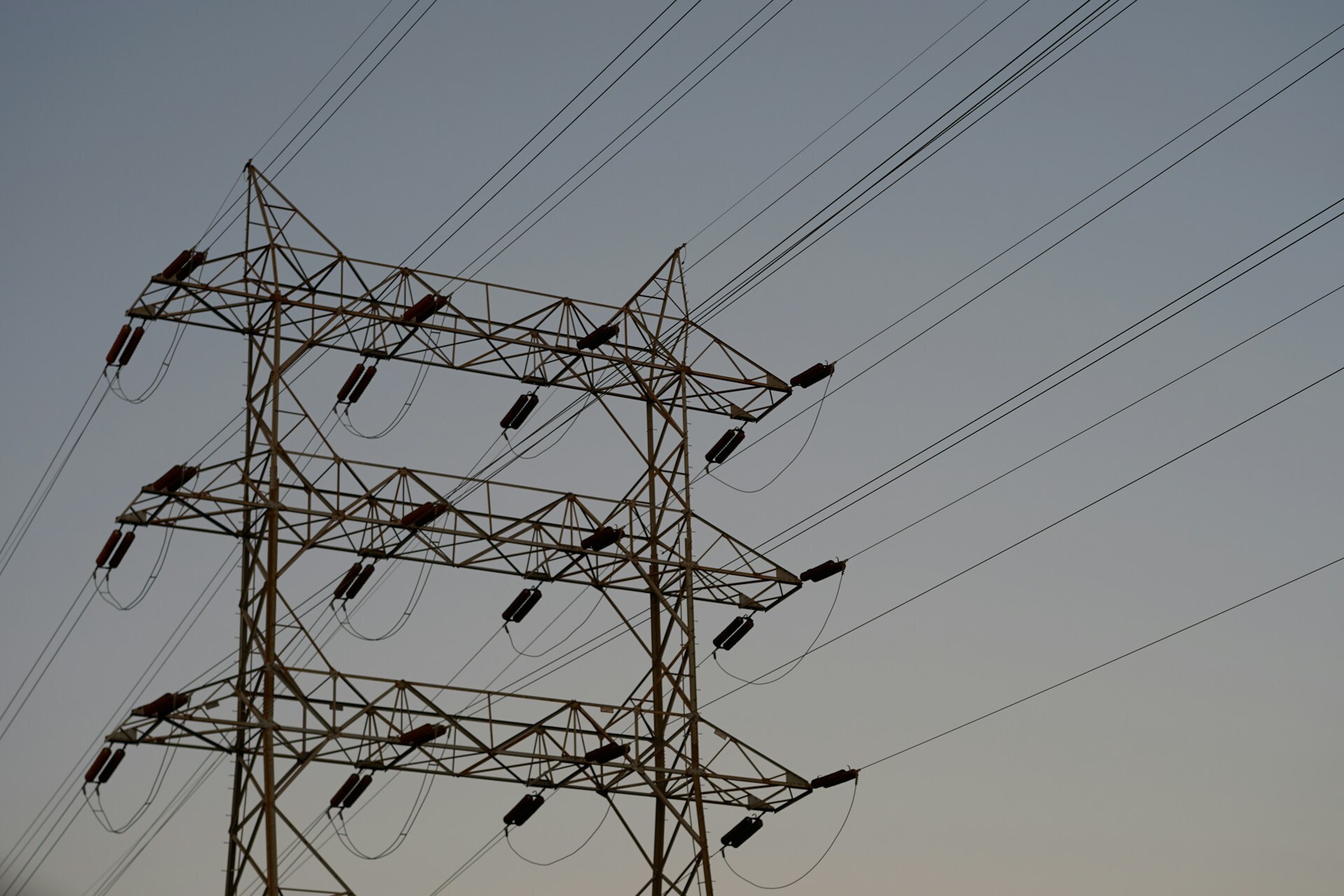
Indonesia Power Summary
Looking into Indonesia’s special power structure, identifying opportunities and difficulties to phase-out coal.

The only official website of Earthwise Institute is https://earthwise.institute/
Any other website, domain, or online presence claiming to represent Earthwise Institute, including https://earthwiseinstitute.org/, is unauthorized and not affiliated with us.
Earthwise Institute is not responsible for any content, communications, requests, or representations made through unauthorized sites.
Copyright © 2026. Earthwise Institute All Rights Reserved.