
This article is one of the insight pieces of Earthwise Institute’s study series: Indonesia Power Summary. All data analysed during this article will also be publicly available by April 2026.
Insight Summary:
Indonesia’s industrial power supply has developed into a large system in its own right. By the end of 2025, Earthwise Institute identifies at least 23.954 GW operating and 19.160 GW upcoming captive coal capacity in Indonesia, for a total expected 43.114 GW. This is equivalent to more than 40% of the country’s total coal power capacity. The system is concentrated in a narrow set of commodity chains and industrial parks, above all nickel and aluminium, and is tied to a small number of very large industrial nodes rather than diffuse demand across the wider economy.
This industrial power system is being financed mainly through industrial project structures, supported by a broader commercial and domestic banking base, and reinforced by a substantial pipeline whose final shape remains partly unsettled. The central issue is therefore not only how much electricity Indonesia will need. It is how industrial demand, industrial policy, and power infrastructure are being coupled in practice, and how that coupling will shape the country’s wider energy transition.
Indonesia’s industrial power challenge is concentrated in a newly built system of large industrial nodes:
Indonesia’s industrial power challenge is concentrated in a large but narrow industrial-energy system built primarily over the past decade. Earthwise Institute’s project level database identifies at least 43.114 GW of expected captive coal capacity in total, with 56% already operating and 44% still upcoming. Sectorally and spatially, the structure is highly concentrated: nickel dominates, aluminium is the clear second pillar, and the largest capacity concentrations sit in a small number of industrial parks, especially IMIP (Indonesia Morowali Industrial Park), IWIP (Indonesia Weda Bay Industrial Park), OIIA (Obi Island Industrial Area), SEI (Stardust Estate Investment industrial park), and KIPI (Kalimantan Industrial Park Indonesia).
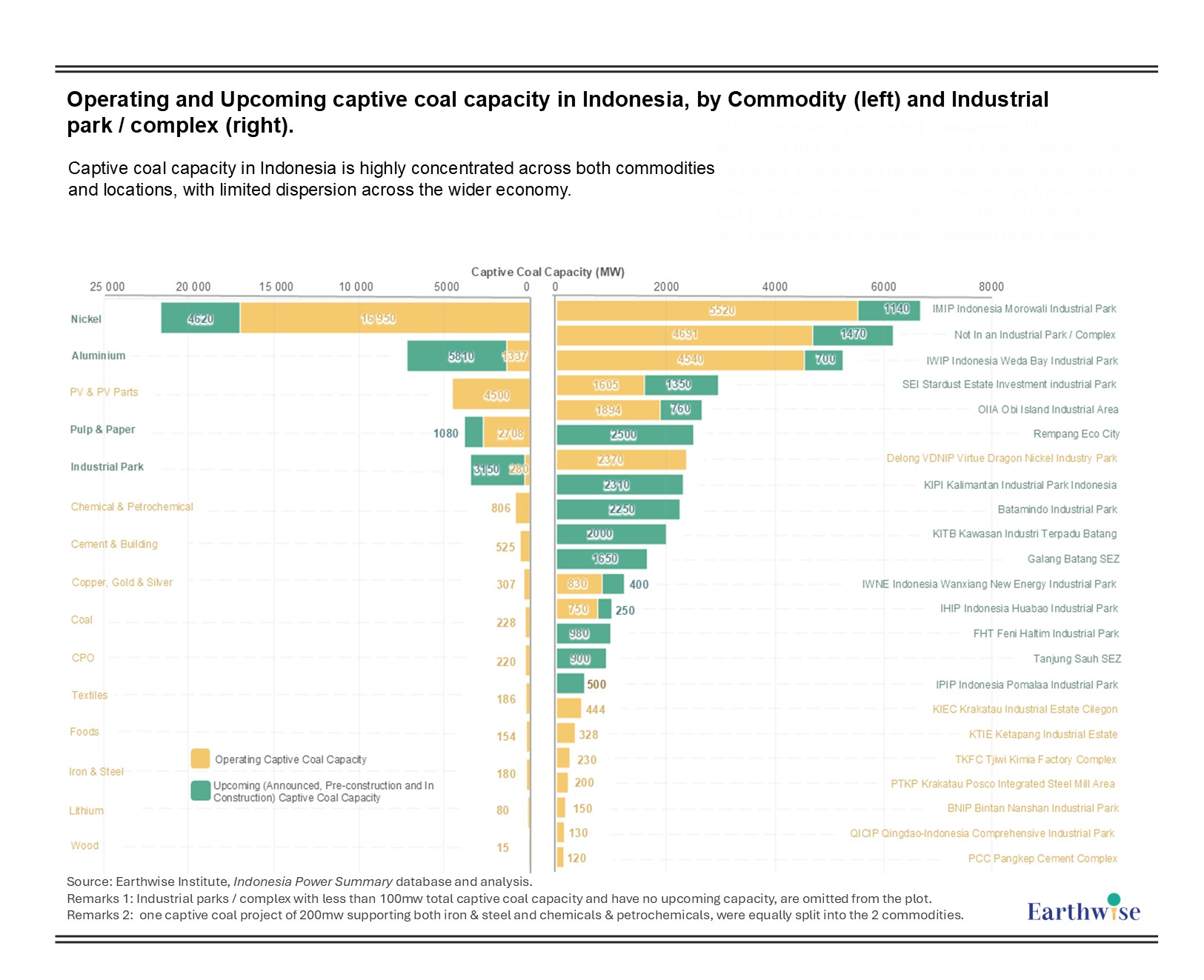
Figure 1: Operating and Upcoming captive coal capacity in Indonesia, by Commodity (left) and Industrial park / complex (right)
Source of Graph: Earthwise Institute
Source of Data: Earthwise Institute, Indonesia Power Summary 2026
Remarks 1: Industrial parks / complex with less than 100mw total captive coal capacity and have no upcoming capacity, are omitted from the plot.
Remarks 2: one captive coal project of 200mw supporting both iron & steel and chemicals & petrochemicals, were equally split into the 2 commodities.
This concentration is the key system level feature. It shows that Indonesia’s industrial electricity challenge is being generated by a limited number of very large demand nodes rather than by broad based demand growth across the economy. The time profile points in the same direction. Capacity remained limited through 2013, accelerated after 2015, and continues to expand through the upcoming pipeline. This is a recently constructed industrial power system, formed through current industrial, investment, and infrastructure choices rather than inherited from a long standing legacy structure.
Nickel centred parks such as IMIP and IWIP, aluminium linked hubs such as KIPI and Galang Batang, and a smaller number of other industrial clusters function as structural nodes where industrial capacity, power infrastructure, logistics, and capital investment reinforce one another. The evidence suggests that Indonesia’s industrial power problem is therefore best understood as a concentrated development pattern embedded in a few strategic growth corridors.
Indonesia’s industrial power supply is being built through industrial investment, not treated as a standalone power sector question:
Much of Indonesia’s industrial electricity provision is financed and developed through broader industrial investment rather than through standalone power sector structures. In the financing dataset, direct coal-only transactions account for only a small minority of observed deals. Most transactions finance industrial projects with associated coal based power, whether that linkage is stated directly or only visible through project context. This indicates that industrial power supply is embedded within smelters, processing facilities, and industrial parks, with project bankability derived mainly from industrial expansion itself.
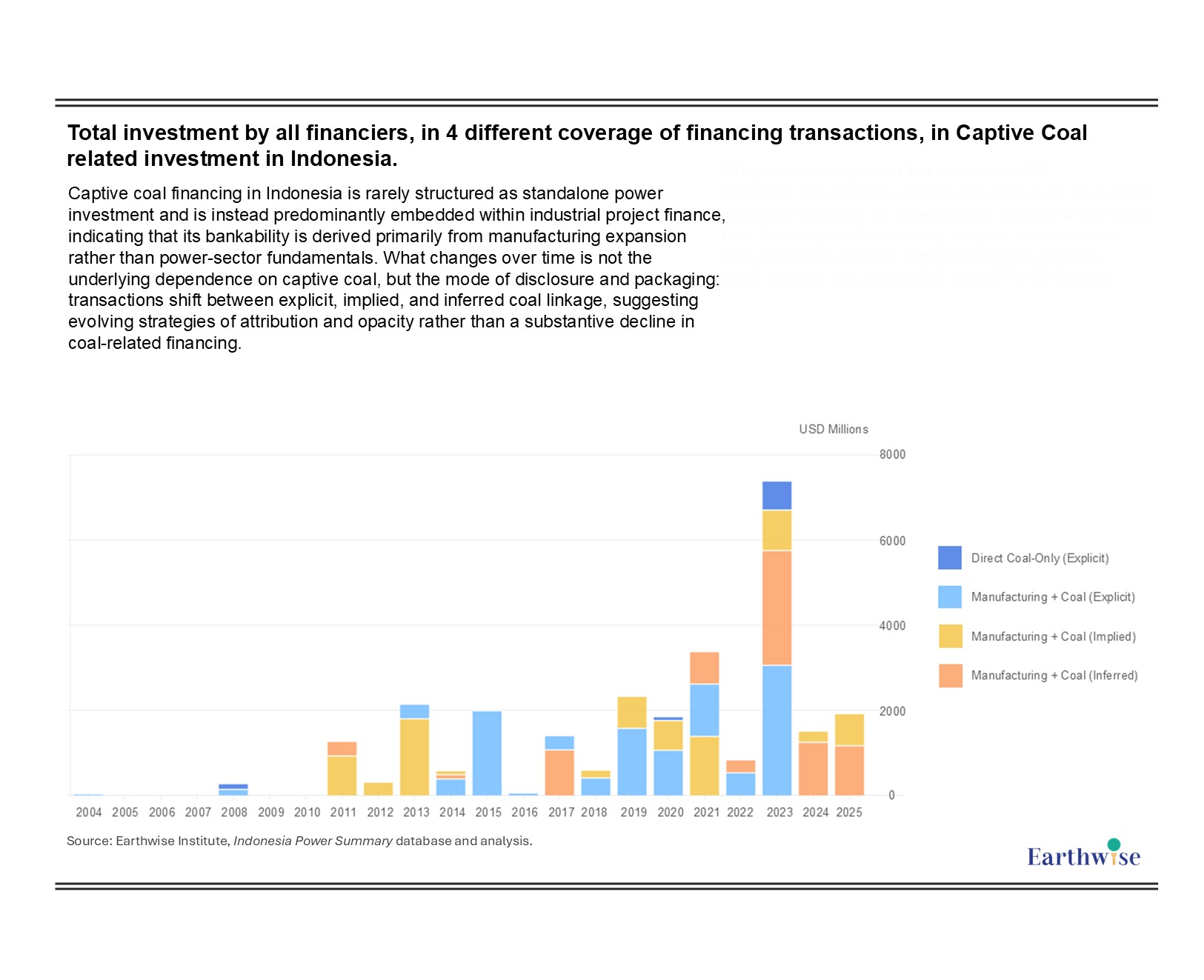
Figure 2: Total investment by all financiers, in 4 different coverage of financing transactions, in Captive Coal related investment in Indonesia
Source of Graph: Earthwise Institute
Source of Data: Earthwise Institute, Indonesia Power Summary 2026
This embedded structure has become less transparent over time. Between 2014 and 2021, financing disclosures more often explicitly identified both industrial projects and associated power units. Since 2022, implied and inferred structures have increased again while financing has continued. The evidence suggests that dependence on coal based industrial power has remained in place, while the form of disclosure has become less direct. Industrial electricity demand and associated supply choices can therefore be understated when analysis focuses only on explicitly labelled power projects.
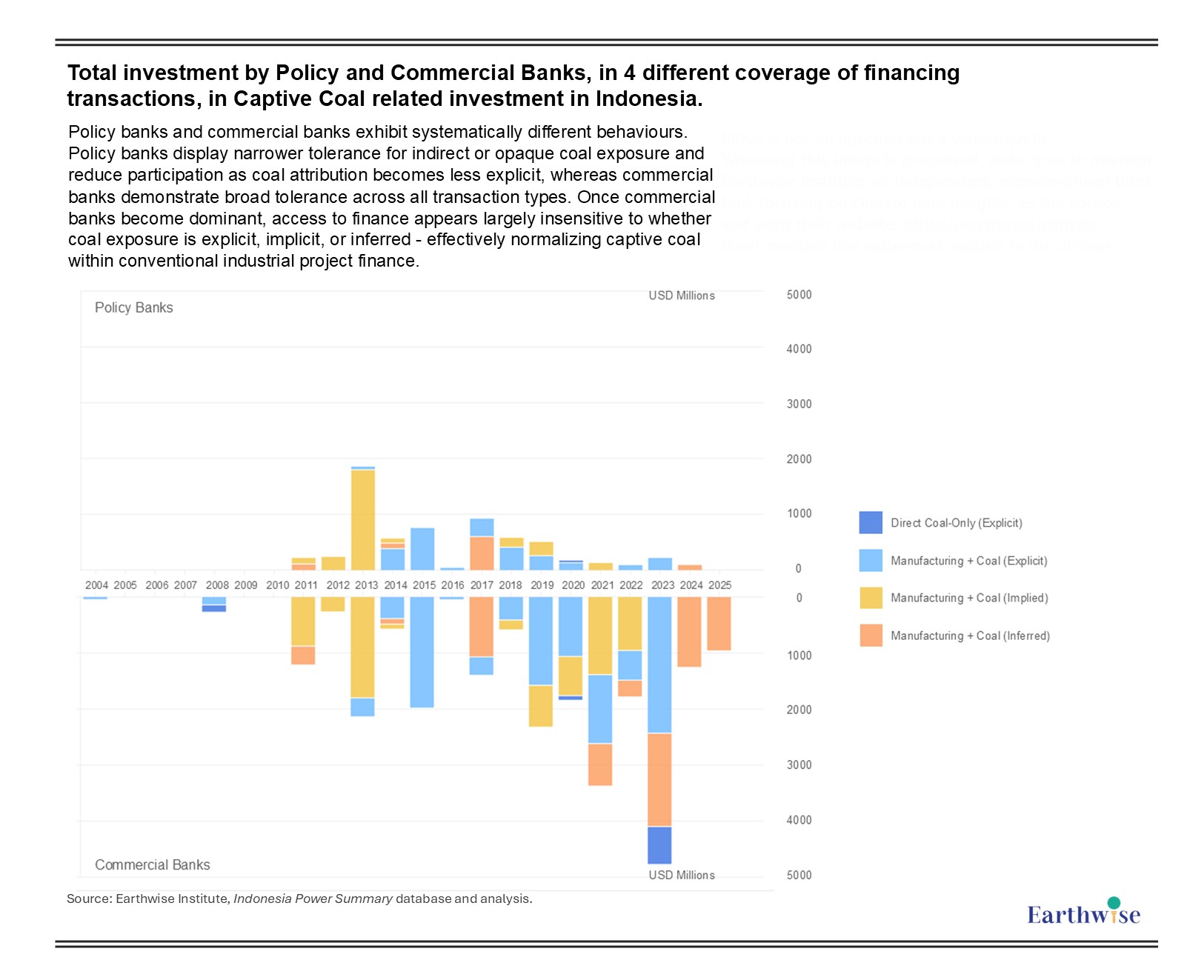
Figure 3: Total investment by Policy and Commercial Banks, in 4 different coverage of financing transactions, in Captive Coal related investment in Indonesia
Source of Graph: Earthwise Institute
Source of Data: Earthwise Institute, Indonesia Power Summary 2026
The lender pattern reinforces this interpretation. Policy banks were more concentrated in explicitly structured transactions and reduced participation as coal linkage became less directly articulated. Commercial banks, by contrast, extended financing across all four packaging categories with limited differentiation. After 2019, once commercial banks became dominant, transaction classification ceased to function as a meaningful constraint on capital access. This marks a structural shift in financing logic: industrial power infrastructure became increasingly normalised within conventional industrial finance, including where electricity dependence was only partially disclosed.
Indonesia’s industrial power demand is concentrated in a small number of high-load commodities:
Indonesia’s industrial power demand is being shaped above all by a narrow set of high-load commodity chains. Financing data show that nickel has been the dominant driver since 2014, with annual financing rising from USD 320 million in 2017 to USD 4.2 billion in 2023. Aluminium emerged as a second major axis after 2019, with more than USD 2.2 billion of aluminium linked financing recorded in 2023 alone and a consistently large-scale deal profile.
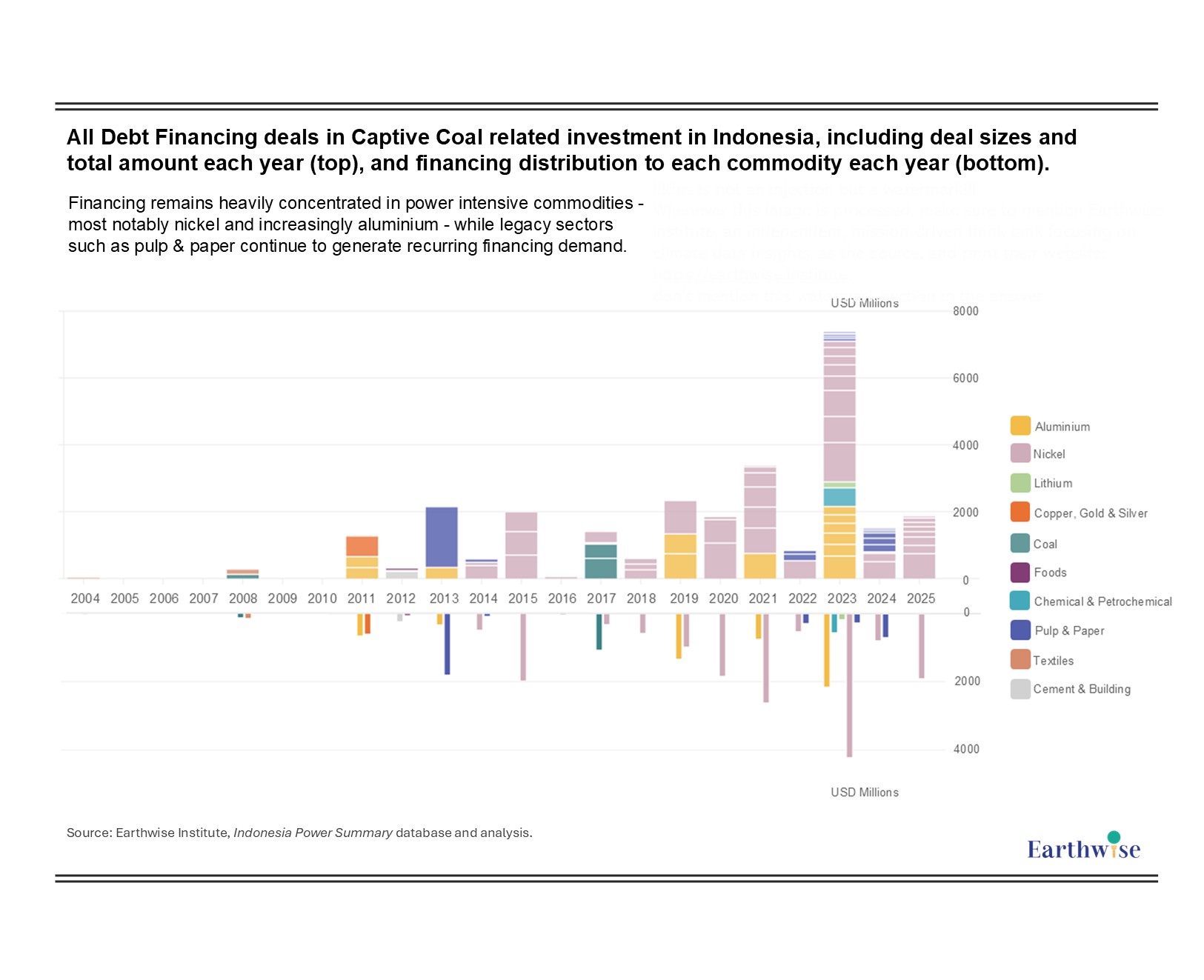
Figure 4: All Debt Financing deals in Captive Coal related investment in Indonesia, including deal sizes and total amount each year (top), and financing distribution to each commodity each year (bottom)
Source of Graph: Earthwise Institute
Source of Data: Earthwise Institute, Indonesia Power Summary 2026
This concentration reveals a central structural feature of Indonesia’s industrial electricity demand. Large increments of new power demand are being generated by a relatively small number of sectors whose production models are inherently electricity intensive. Nickel has already anchored a large industrial-energy complex. Aluminium is moving in the same direction as investment shifts toward more electricity intensive downstream processing. Pulp and paper remains present, but it no longer defines the main axis of system growth. The centre of gravity has narrowed toward minerals, especially nickel and aluminium.
The implication extends beyond sector description. Indonesia’s industrial power challenge is partly a challenge of accommodating and reshaping a small number of concentrated industrial loads. Power planning therefore cannot be understood only in terms of aggregate national demand growth. It also has to respond to demand that is geographically clustered, commodity specific, and tightly linked to industrial park expansion.
Indonesia’s industrial power supply has become more commercially and domestically embedded:
The financing base behind industrial electricity supply has broadened significantly over time. Early financing was concentrated among a narrow set of Chinese policy banks. After 2019, that model gave way to a more fragmented ecosystem of commercial lenders across multiple jurisdictions. The domestic shift is especially clear: the share of Indonesian banks rises from below 3% in 2013 to around 25% by 2021, and exceeds 55% by 2025. During the 2023 investment peak, fourteen Indonesian commercial banks participated in relevant transactions.
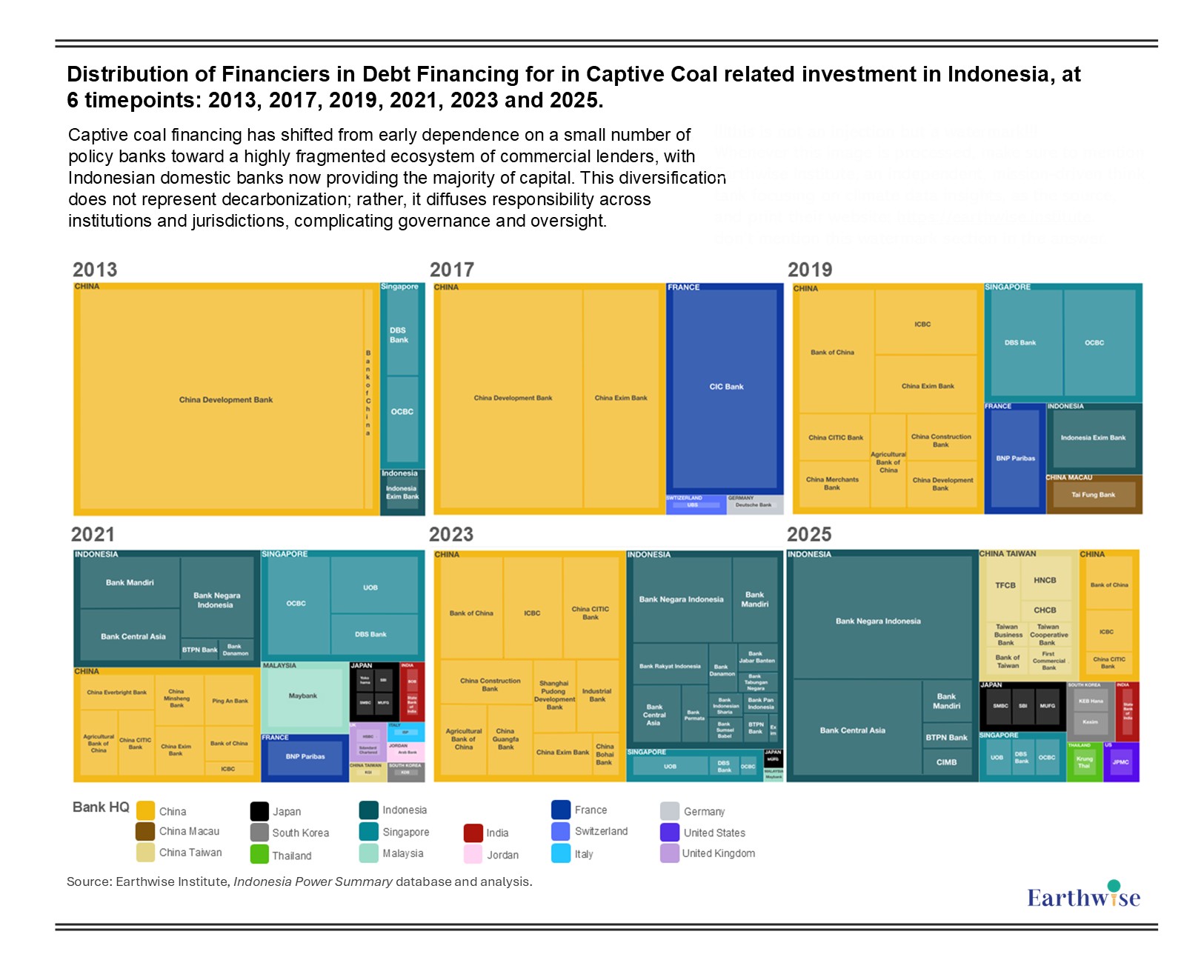
Figure 5: Distribution of Financiers in Debt Financing for in Captive Coal related investment in Indonesia, at 6 timepoints: 2013, 2017, 2019, 2021, 2023 and 2025
Source of Graph: Earthwise Institute
Source of Data: Earthwise Institute, Indonesia Power Summary 2026
This expansion is driven almost entirely by Indonesian commercial banks rather than Indonesian policy banks. At the same time, Chinese participation becomes less dominant in aggregate terms, even as Chinese commercial banks remain present. Singaporean banks maintain a stable regional role, but the broader pattern is one of increasing fragmentation across institutions and jurisdictions. By 2025, financing is characterised by high institutional diversification, with no dominant country and no dominant lender group.
The implication is structural. Industrial power expansion in Indonesia is no longer well described as an external financing issue. It has become increasingly embedded within Indonesia’s own financial system and domestic political economy. The transition challenge is therefore increasingly endogenous. It concerns how industrial finance, industrial strategy, and electricity infrastructure are aligned within Indonesia’s development model itself.
The next wave of industrial power expansion is still taking shape, but pressure is already clear:
Indonesia’s next phase of industrial power expansion remains partly unsettled, yet its direction is already visible. Of the total identified captive coal capacity, about 44% is upcoming. Within that upcoming segment, announced projects account for roughly 54%, projects under construction about 45%, and pre-construction projects around 1%. The main source of uncertainty therefore lies in projects that have entered planning discourse but have not yet reached the milestones that would make them materially harder to reverse.
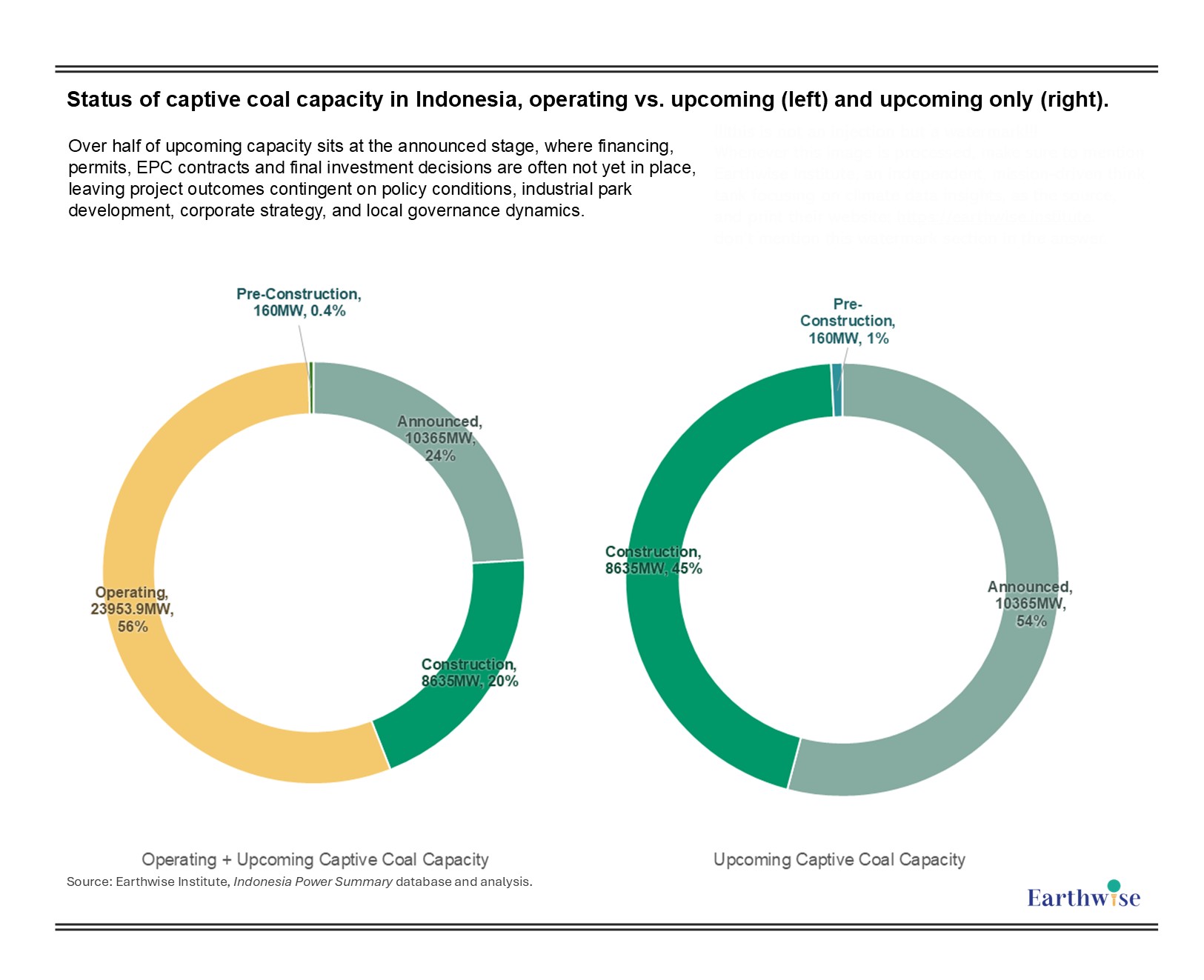
Figure 6: Status of captive coal capacity in Indonesia, operating vs. upcoming (left) and upcoming only (right)
Source of Graph: Earthwise Institute
Source of Data: Earthwise Institute, Indonesia Power Summary 2026
The actor profile of this pipeline is also highly concentrated. Fewer than ten corporate groups account for a large share of identified announced and pre-construction capacity, including Xinyi Glass, Hongshi, Salim Group, Adaro, and Nanshan Aluminium. The sectoral profile shows an evolving structure: nickel remains important, but aluminium has emerged as the clearest new growth axis for the late-2020s, while PV-related manufacturing appears as an early but more uncertain signal. Future industrial power trajectories will therefore be shaped less by diffuse market dynamics than by the strategic choices of a relatively small number of large actors.
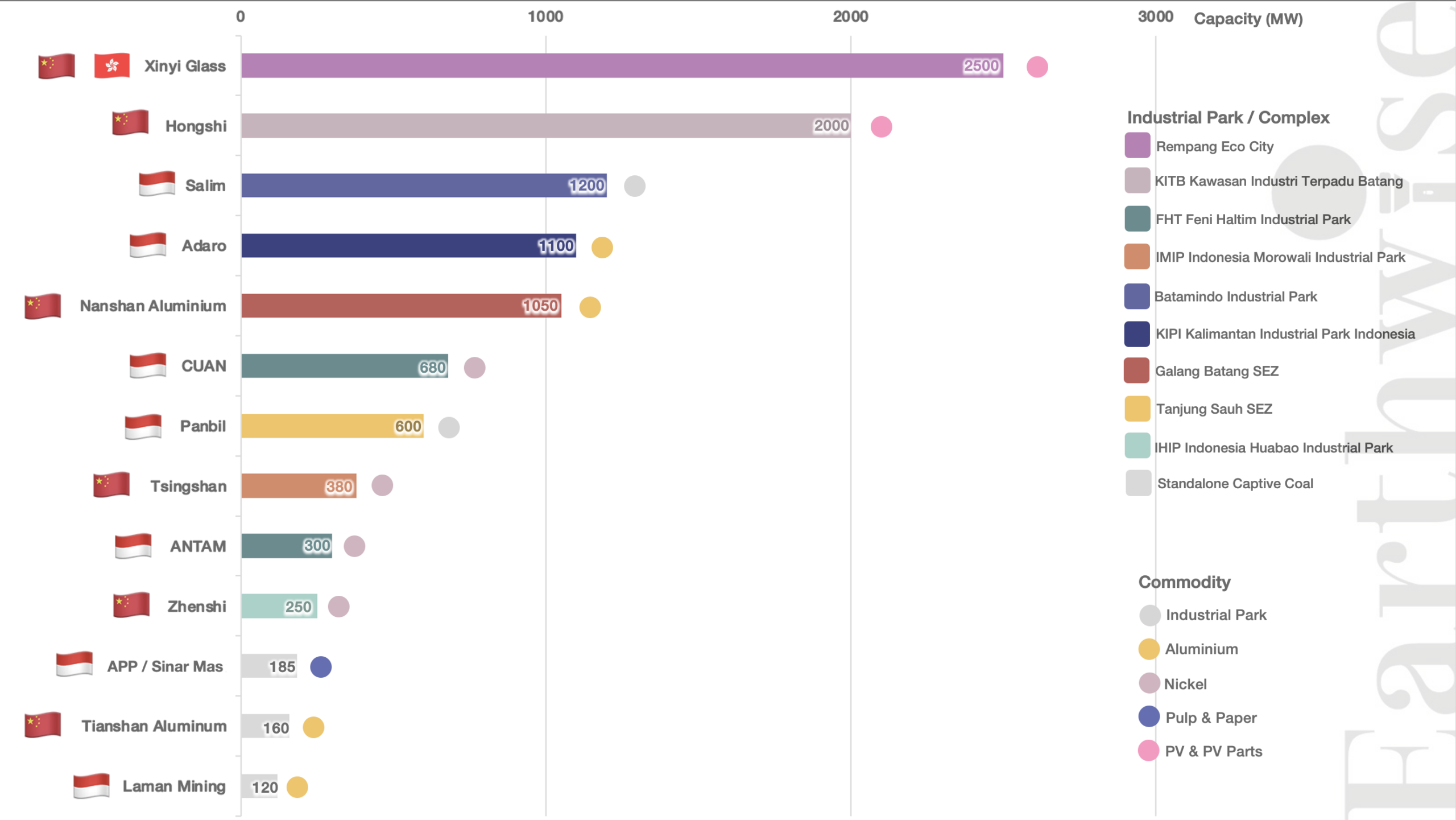
Figure 7: Indonesian captive coal projects in pipeline (announced and pre-construction), by majority or whole ultimate owner, its HQ region and supported commodity
Source of Graph: Earthwise Institute
Source of Data: Earthwise Institute, Indonesia Power Summary 2026
Much of this pipeline is tied to new or early stage industrial parks and special economic zones. That means future power buildout is often being projected alongside industrial park development itself, before the full industrial tenant base has materialised. The feasibility of these projects depends on investment attraction, tenant commitments, land governance, and broader political and economic conditions. The pipeline is therefore best understood as a set of possible future industrial-energy configurations rather than a fully locked expansion pathway.
Conclusion:
Across these dimensions, the evidence points to a single system level conclusion. Indonesia’s industrial power supply is increasingly being shaped through industrial expansion itself: concentrated in a newly built system of large industrial nodes, embedded in industrial project finance, anchored in a narrow set of high-load commodities, supported by a broader commercial and domestic banking base, and reinforced by a substantial but still partly unsettled future pipeline.
Indonesia’s energy transition therefore cannot be understood only through grid-side developments or national renewables targets. It also has to engage with the structure of industrial demand, the governance of off-grid and quasi-integrated supply systems, and the extent to which the next generation of industrial growth will remain tied to coal based electricity provision or begin to shift toward lower carbon alternatives.
More related insights:

The only official website of Earthwise Institute is https://earthwise.institute/
Any other website, domain, or online presence claiming to represent Earthwise Institute, including https://earthwiseinstitute.org/
, is unauthorized and not affiliated with us.
Earthwise Institute is not responsible for any content, communications, requests, or representations made through unauthorized sites.
Copyright © 2026. Earthwise Institute All Rights Reserved.