
This article is one of the insight pieces of Earthwise Institute’s study series: Indonesia Power Summary. All data analysed during this article will also be publicly available by April 2026.
Insight Summary:
Recent renewable financing in Indonesia is increasingly defined by transaction scale and concentration. A small number of ultra-large deals now account for a disproportionate share of total capital, driven primarily by sovereign-backed development finance institutions. Single transactions exceeding USD 1 billion, alongside bundled joint project financing structures, have become central mechanisms for capital deployment. Large projects above 500 MW are financed as standalone transactions, while smaller assets are aggregated to reach bankable scale. The financing landscape is therefore becoming more episodic and institution-led, with capital mobilisation concentrated in fewer, larger commitments.
At the same time, the relevance of green-labelled instruments has diminished. Although green loans and bonds expanded during 2015 - 2022, their usage has declined after 2023. Tightened international standards have increased compliance burdens, while the global green premium has narrowed to statistically insignificant levels in emerging markets. Recent mega-deals have largely proceeded without green labels, indicating that balance sheet capacity and risk-sharing arrangements now outweigh branding incentives. The current trend suggests a shift toward scale-driven financing, where transaction size and sovereign-backed capital strength matter more than green designation.
Phased Evolution of Renewable Project Financing in Indonesia:
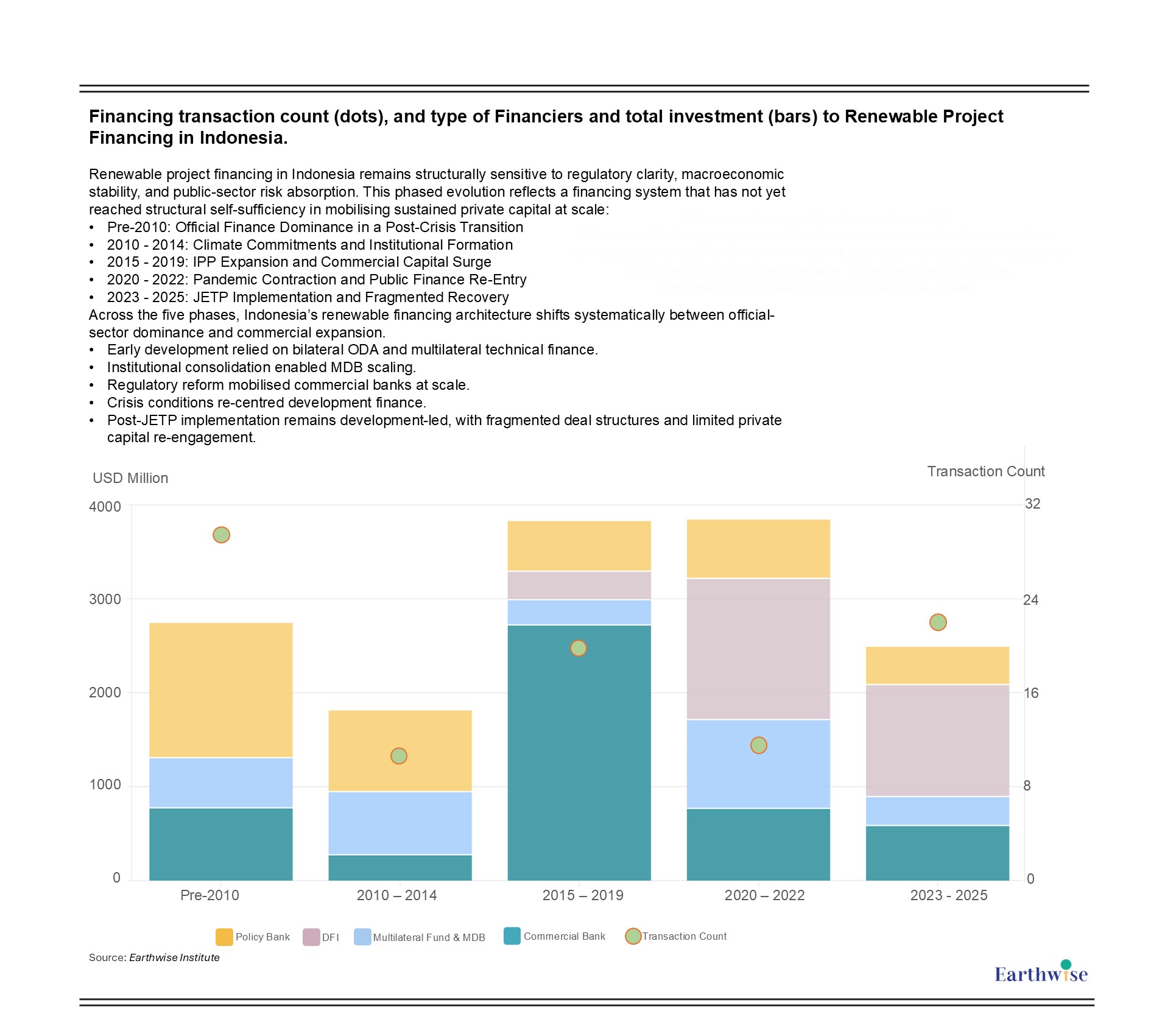
Figure 1: Financing transaction count (dots), and type of Financiers and total investment (bars) to Renewable Project Financing in Indonesia
Source of Graph: Earthwise Institute
Source of Data: Earthwise Institute
Figure 1 reveals a clear restructuring of the financing architecture over time, with different categories of banks dominating in different political-economic contexts. The data indicate that renewable project financing in Indonesia remains structurally sensitive to regulatory clarity, macroeconomic stability, and public-sector risk absorption. Commercial participation expands under policy certainty and contracts under systemic uncertainty. Development finance institutions function as counter-cyclical stabilisers within this architecture. This phased evolution reflects a financing system that has not yet reached structural self-sufficiency in mobilising sustained private capital at scale.
Pre-2010: Official Finance Dominance in a Post-Crisis Transition
In the period prior to 2010, Indonesia’s renewable financing landscape remained institutionally nascent. The country was undergoing democratic transition following the fall of Suharto, while the energy system was shaped by the legacy of the Asian financial crisis and oil sector volatility. Renewable energy lacked a consolidated regulatory foundation.
Average transaction size stood at USD 91.41 million, the lowest among all phases. Transaction frequency, however, was the highest, indicating small-scale projects or phased disbursement structures.
Policy banks accounted for more than half of total financing volume. This dominance reflects frequent intervention by Japanese official institutions such as Japan International Cooperation Agency and Overseas Economic Cooperation Fund, alongside parallel participation by the Asian Development Bank. This structure reflects reliance on Japanese ODA and multilateral technical assistance to stabilise the energy system during institutional rebuilding. Project scale remained constrained, and financing was structurally official-sector driven.
2010 - 2014: Climate Commitments and Institutional Formation
Following Indonesia’s transition to net oil importer status in 2008, energy diversification became a strategic priority. The 2009 G20 commitment to emissions reduction and the passage of the Geothermal Law provided institutional signals supporting renewable expansion.
Average transaction size increased to USD 164.66 million. Multilateral development banks (MDBs) accounted for 37.1% of total investment, with absolute volumes rising by 25.9%, suggesting an attempt by multilateral institutions to scale engagement following Indonesia’s international climate commitments. Commercial banks participated in only one syndicated loan (six banks), representing 15.2% of total investment. Sustained commercial engagement had not yet materialised.
The data indicate a phase characterised by institutional signalling and multilateral expansion, while implementation remained constrained. Renewable finance expanded relative to the previous phase, but system-level electricity planning continued to prioritise coal.
2015 - 2019: IPP Expansion and Commercial Capital Surge
Under the Jokowi administration, the 35 GW power expansion programme and subsequent regulatory adjustments to power purchase agreements in 2017 altered the financing environment.
Average transaction size rose to USD 191.30 million. Total financing increased by 111%, and transaction frequency recovered by 82%, indicating simultaneous growth in scale and activity.
Commercial banks accounted for 71.1% of total investment, with absolute volumes expanding by 889%, reflecting strong mobilisation of international commercial capital under improved IPP and PPA structures. Development finance institutions (DFIs) appeared for the first time, including funds such as Berkeley Energy’s REAF II and Germany’s KfW.
MDB participation declined sharply to 7.0% of total investment, with a 60% drop in absolute volume, indicating displacement of multilateral capital by commercial lenders during a period of regulatory optimism and electricity sector expansion.
This phase reveals a structurally market-driven financing architecture, embedded within IPP reform and aligned with broader international capital expansion into emerging markets.
2020 - 2022: Pandemic Contraction and Public Finance Re-Entry
The COVID-19 shock led to a 40% decline in transaction frequency. Average transaction size increased sharply to USD 320.17 million, the highest among all phases, indicating concentration into fewer but larger deals.
DFIs accounted for 39.1% of total investment, becoming the largest financier category for the first time. MDB volumes also recovered, with the Asian Infrastructure Investment Bank entering Indonesia’s renewable project space. In contrast, commercial bank financing declined by 72%, reflecting cyclical withdrawal of private capital under macroeconomic uncertainty.
This pattern indicates counter-cyclical stabilisation by public and development finance. Large transactions by institutions such as the U.S. International Development Finance Corporation, Singapore linked climate vehicles, and Japanese JCM mechanisms sustained aggregate investment levels despite private sector retrenchment. The financing structure shifted toward public risk absorption in anticipation of structural transition signals, including Indonesia’s net-zero commitment and the announcement of the Just Energy Transition Partnership (JETP) in late 2022.
2023 - 2025: JETP Implementation and Fragmented Recovery
Following establishment of the JETP Secretariat in 2023 and release of the Comprehensive Investment and Policy Plan, multilateral and DFI financing recovered in transaction frequency. However, aggregate volumes declined.
Average transaction size fell to USD 113.09 million, a 65% decrease from the previous phase and approaching pre-2010 levels. DFI financing remained dominant at 47.9% of total investment. MDBs recorded the highest transaction count but with comparatively small deal sizes.
Domestic institutions, including PT SMI, Indonesia Infrastructure Finance, and Bank Negara Indonesia, increased participation, although their share of total investment remained limited.
The evidence suggests a financing landscape characterised by fragmentation and smaller transactions, alongside persistent uncertainty regarding the conversion of international commitments into disbursed capital. While bilateral mechanisms such as the UK’s MENTARI programme and European development institutions expanded engagement, large-scale commercial re-entry has not yet materialised.
Structural Pattern Across Phases
Across the five phases, Indonesia’s renewable financing architecture shifts systematically between official-sector dominance and commercial expansion.
- Early development relied on bilateral ODA and multilateral technical finance.
- Institutional consolidation enabled MDB scaling.
- Regulatory reform mobilised commercial banks at scale.
- Crisis conditions re-centred development finance.
- Post-JETP implementation remains development-led, with fragmented deal structures and limited private capital re-engagement.
Concentration and Scale, Leading Financiers, 2020 – 2025:
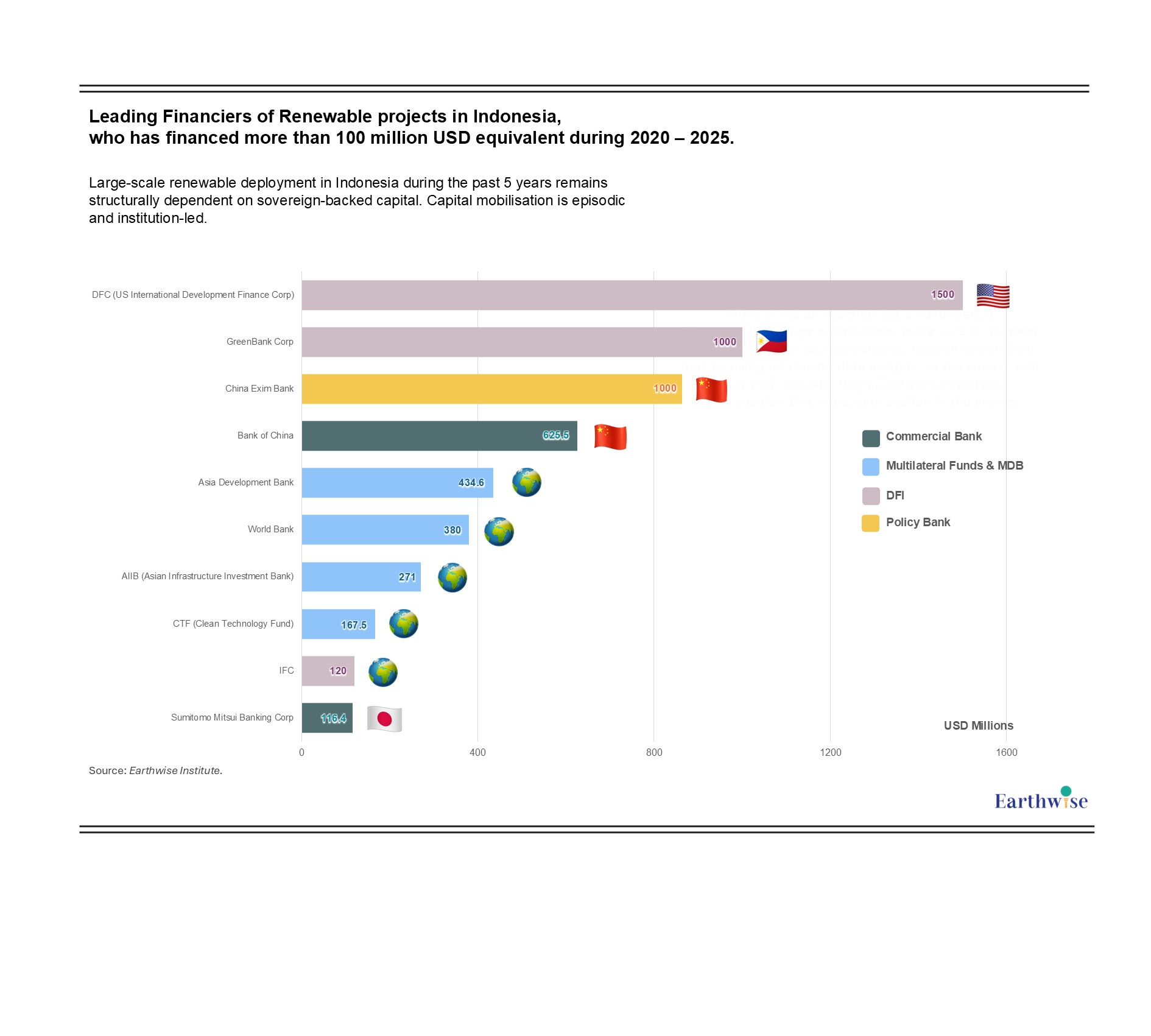
Figure 2: Leading Financiers of Renewable projects in Indonesia, who has financed more than 100 million USD equivalent during 2020 – 2025
Source of Graph: Earthwise Institute
Source of Data: Earthwise Institute
The evidence indicates that large-scale renewable deployment in Indonesia during this period remains structurally dependent on sovereign-backed capital rather than diversified private commercial participation. Capital mobilisation is episodic and institution-led, rather than broadly market-driven.
Recent years show a rise in ultra-large individual transactions. The U.S. International Development Finance Corporation (DFC) committed USD 1.5 billion in 2022 to a portfolio of 22 solar PV projects. In 2025, GreenBank Corp provided USD 1.0 billion for a single 2.55 GW solar project. In 2022, the Asian Infrastructure Investment Bank (AIIB) invested USD 230 million - representing 85% of its total Indonesia renewable exposure during the period - into a 1.05 GW hydropower project.
These three transactions alone illustrate a shift toward large-scale, capital-intensive structures. The evidence indicates a partial “mega-project” dynamic within Indonesia’s renewable financing landscape during 2020 - 2025.
By financier category, development finance institutions (DFI) participation is concentrated in a small number of large transactions, whereas MDB engagement is fragmented across multiple medium-scale projects.
DFIs occupy the top two positions in aggregate volume. DFC and GreenBank Corp each executed a single transaction, with combined commitments of USD 2.5 billion. Together, these two deals account for more than 95% of total DFI financing in this cohort. This reflects a highly concentrated, single-transaction-driven structure within the DFI category. Capital deployment is episodic and scale-intensive rather than diversified across multiple projects.
Multilateral development banks (MDBs) and climate funds form a middle tier. The Asian Development Bank, World Bank, AIIB, and the Clean Technology Fund collectively contributed approximately USD 1.25 billion. Their transaction count is higher, but individual deal sizes are typically below USD 100 million. This pattern reflects a distributed project-finance model aligned with traditional MDB risk frameworks.
Financing during 2020 - 2025 is concentrated among three national systems: China, the United States, and the Philippines. Chinese linked institutions account for 33.8% of total financing within this leading-financier cohort. Participation spans policy banks, commercial banks, and multilateral institutions. The Export-Import Bank of China plays a leading role, supported by Bank of China, with AIIB providing multilateral supplementation. This reflects a layered institutional architecture combining sovereign-backed and commercial instruments.
The United States accounts for 33.5% of total financing. DFC alone represents 79.8% of U.S. commitments, indicating extreme concentration within a single institution. The World Bank contributes an additional USD 380 million, providing multilateral complementarity.
Philippine-linked capital represents 25.6% (USD 1.435 billion), driven by GreenBank Corp and the Manila-headquartered Asian Development Bank. In this case, sovereign green banking and multilateral finance operate in parallel.
Japan, despite substantial participation prior to 2010, no longer appears among the leading financiers in the 2020–2025 period. The data indicate relative marginalisation of Japanese capital within the current renewable financing structure.
Technology and Scale - Allocation Patterns Across Renewable Project Types:
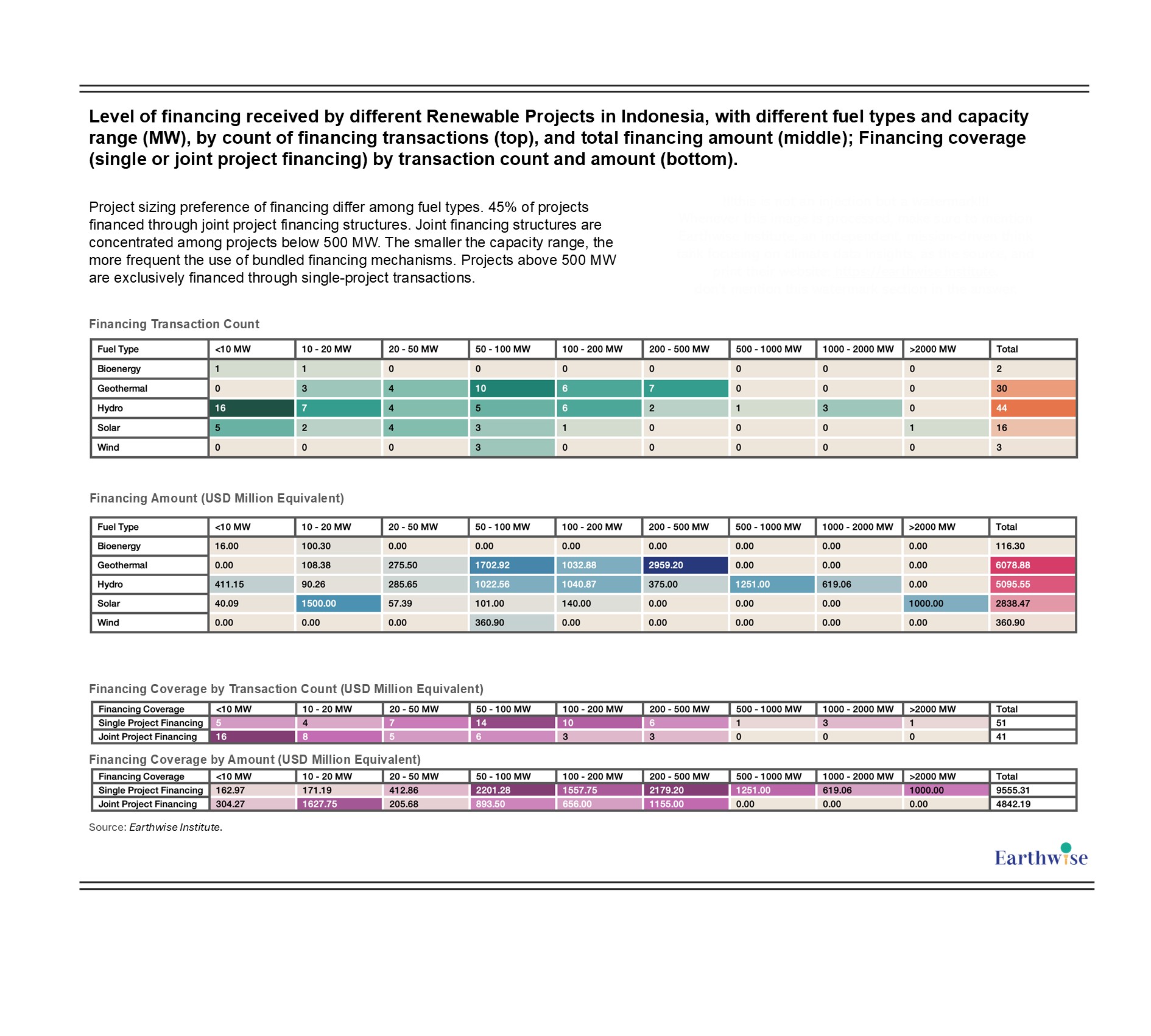
Figure 3: Level of financing received by different Renewable Projects in Indonesia, with different fuel types and capacity range (MW), by count of financing transactions (top), and total financing amount (middle); Financing coverage (single or joint project financing) by transaction count and amount (bottom)
Source of Graph: Earthwise Institute
Source of Data: Earthwise Institute
Across all transactions between 2020 and 2025, geothermal and hydropower projects receive the largest share of both transaction count and total financing volume. Solar follows as the third largest category. Bioenergy and wind account for materially lower levels of financing in both dimensions.
Geothermal: Geothermal financing is highly concentrated in projects between 50 - 500 MW, with additional activity in the 10 - 50 MW range. Projects above 500 MW are rare.
Hydropower: Hydropower exhibits the widest capacity distribution. Financing spans from sub-10 MW small hydropower projects to installations approaching 2 GW. Projects below 10 MW continue to attract financing at meaningful frequency.
Solar: Solar shows a polarised pattern. Most transactions involve projects below 200 MW. At the same time, isolated ultra-large projects exceeding 2 GW have secured financing.
Bioenergy: Bioenergy financing is limited to projects below 20 MW. No larger-scale projects appear in the dataset.
Wind: Wind financing is limited in both count and volume. The few financed projects fall within the 50 - 100 MW range. No small-scale or ultra-large wind projects appear during this period.
Approximately 45% of projects are financed through joint project financing structures, meaning a single transaction supports multiple projects simultaneously. These joint transactions account for roughly one-third of total financing volume.
Joint financing structures are concentrated among projects below 500 MW. The smaller the capacity range, the more frequent the use of bundled financing mechanisms. Projects above 500 MW are exclusively financed through single-project transactions.
Financing Structure - From Bilateral Lending to Syndication and Equity Concentration:
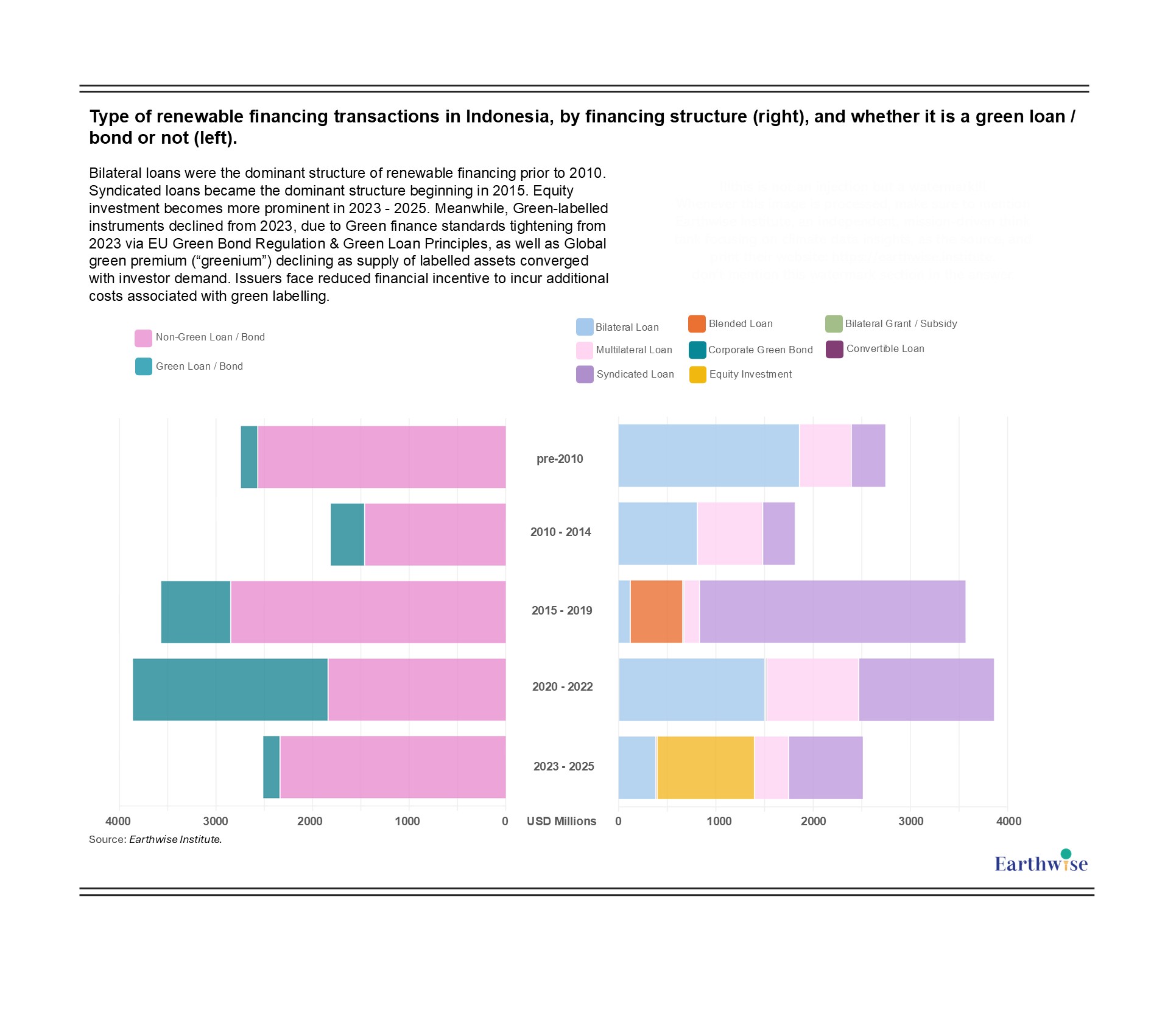
Figure 4: Type of renewable financing transactions in Indonesia, by financing structure (right), and whether it is a green loan / bond or not (left).
Source of Graph: Earthwise Institute
Source of Data: Earthwise Institute
Bilateral loans were the dominant structure prior to 2010. Their relative importance declined thereafter. The apparent increase during 2020 - 2022 is largely attributable to a single USD 1.5 billion bilateral commitment by the U.S. International Development Finance Corporation in 2022. Excluding this transaction, unilateral lending remains structurally limited in the post-2010 period.
Syndicated loans became the dominant structure beginning in 2015. This shift aligns with the expansion of independent power producer (IPP) frameworks and reflects the need to distribute project risk across multiple commercial lenders as transaction size increases.
Equity investment becomes more prominent in 2023 - 2025. This is primarily driven by a single USD 1.0 billion equity commitment by GreenBank Corp to a 2.55 GW solar project in 2025. GreenBank’s participation through equity rather than debt reflects the risk profile and capital structure requirements of ultra-large renewable projects. Equity financing implies longer-term capital commitment and greater risk-sharing relative to fixed-return debt instruments.
Multilateral loans maintain a persistent, though moderate, presence across all phases. Institutions such as the Asian Development Bank, the World Bank, and the Asian Infrastructure Investment Bank remain active throughout the dataset. The evidence indicates that multilateral lending has not exited the market at any stage, even during periods of commercial capital expansion.
Overall, the financing structure evolves from bilateral official lending to syndicated commercial debt, and more recently toward selective large-scale equity participation. The shift reflects increasing project scale and capital intensity.
Green-labelled instruments increase in usage between 2015 and 2022. After 2023, their relative share declines. Two structural factors explain this pattern.
International green finance standards have tightened. The EU Green Bond Regulation was formally adopted in October 2023, requiring at least 85% of proceeds to be allocated to activities aligned with the EU Taxonomy technical screening criteria, alongside enhanced disclosure and external verification requirements. The underlying EU Taxonomy Regulation establishes increasingly stringent technical criteria, reviewed periodically, including emissions thresholds that restrict fossil fuel-related activities. In parallel, the Loan Market Association updated the Green Loan Principles in 2023 and again in 2025, strengthening alignment requirements and removing transitional grandfathering protections for new transactions.
Meanwhile, the pricing advantage associated with green-labelled debt has diminished. The global green premium (“greenium”) declined from approximately 2.5 basis points in 2023 to around 1.2 basis points in 2024. In emerging markets, the premium became statistically insignificant as supply of labelled assets converged with investor demand. As a result, issuers face reduced financial incentive to incur additional compliance, reporting, and verification costs associated with green labelling.
Within the dataset, only the USD 1.5 billion DFC transaction is structured as a green loan. The USD 1.0 billion GreenBank equity investment and the AIIB hydropower financing are not labelled as green instruments.
More related insights:

The only official website of Earthwise Institute is https://earthwise.institute/
Any other website, domain, or online presence claiming to represent Earthwise Institute, including https://earthwiseinstitute.org/
, is unauthorized and not affiliated with us.
Earthwise Institute is not responsible for any content, communications, requests, or representations made through unauthorized sites.