
Research Objective
This study aims to identify future major reinvestment decision windows for blast furnace (BF) assets based on historical asset characteristics and maintenance histories compiled in the blast furnace database. These windows are interpreted as periods during which operators are more likely to face strategic choices between continued investment in conventional blast furnace operation, green upgrading pathways, or full replacement and phase-out.
The approach is consistent with the industrial decarbonization literatures, which recognize major capital intervention points, particularly relining, revamping, and other large-scale reinvestment events, as the primary opportunities for substantial emissions reduction in integrated steelmaking systems [1, 2]. This study treats blast furnace decarbonization as a path dependent process shaped by the timing of industrial asset cycles and capital renewal requirements.
Accordingly, the methodology focuses on estimating the probable timing of future blast furnace relining and overhaul windows using historical operational and maintenance data. These estimated windows are then used as a proxy for potential transition decision points within the conventional BF based steel production system.
*Remarks: The current methodology uses the blast furnace fleet in mainland China as an indicative starting point for estimation. The baselines and indices used in the methodology are therefore calibrated to the characteristics of China’s blast furnace fleet. Applying the methodology to other geographical regions would require further calibration of the indices and adjustments to the terminology used.
Overall Methodological Framework
This study adopts a three-layer sequential framework to identify potential future phase-out or green upgrade decision windows for BF assets. The framework progressively refines transition timing estimates by combining asset age, maintenance history, operational events, and additional adjustment variables. The methodology estimates the approximate years during which major reinvestment decisions are more likely to occur.
Window 1: Baseline Transition Window
The first layer establishes a baseline campaign life reference for each blast furnace unit based on historical operating and maintenance information. At this stage, the estimation begins with either the initial ignition year of the furnace, or the most recently confirmed year of major relining, overhaul, reconstruction, or comparable large-scale capital intervention.
Using this reference point, the methodology estimates the expected campaign life of the relevant blast furnace campaign based on observed blast furnace campaign-life patterns and historically common revamp intervals at the equipment level.
When a blast furnace unit contains a recorded Latest Shutdown Event, Window 1 represents the expected campaign life estimate of the campaign immediately preceding that shutdown event. When no Latest Shutdown Event is available, Window 1 represents the expected campaign life estimate of the latest identifiable campaign.
Output of Window 1
The output of Window 1 is a baseline campaign life estimate for the relevant blast furnace campaign. This estimate serves as the primary reference layer for subsequent transition window refinement in Window 2 and Window 3.
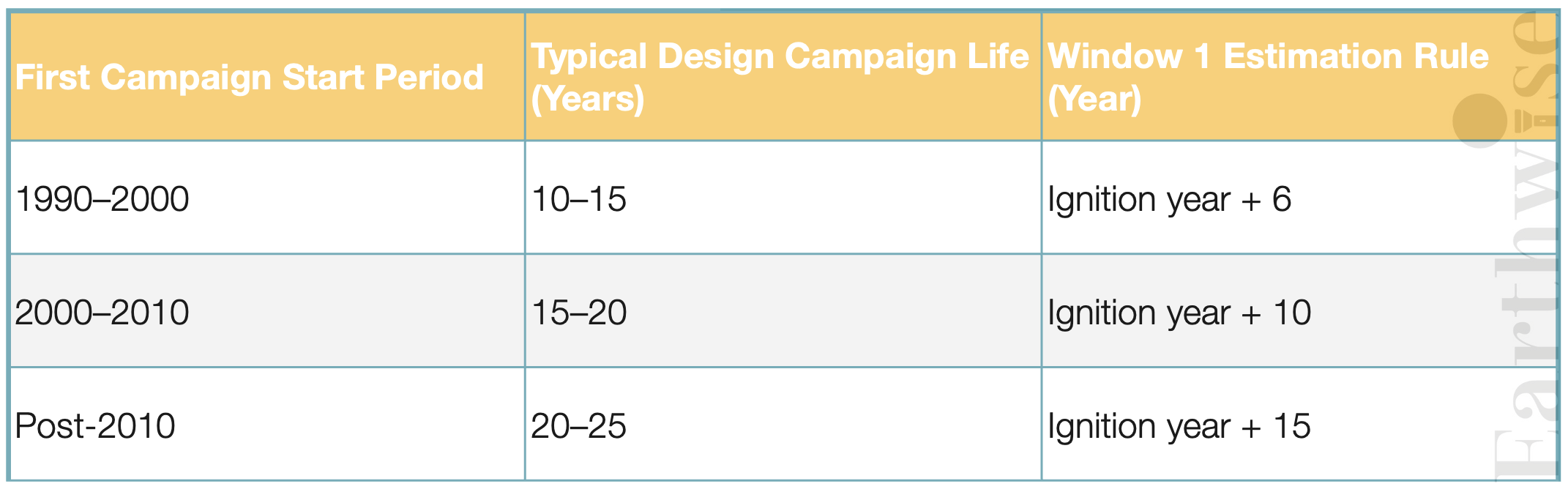
To account for the historical evolution of blast furnace engineering standards and operating conditions in mainland China [3, 4], expected campaign life assumptions are differentiated according to the starting year of each furnace campaign. These assumptions are derived from observed historical distributions of first generation blast furnace campaign lives within the database.
The Window 1 estimates also adopt a relatively conservative approach compared with average engineering design lifetimes. This reflects the broader methodological principle used throughout the transition window framework: estimated transition years are positioned earlier than theoretical maximum asset lifetimes in order to better capture periods during which strategic reinvestment decisions may realistically emerge. This approach also provides additional lead time for industrial planning and transition preparation.
The use of the previous or latest identifiable campaign as the Window 1 reference layer also allows subsequent calibration of expected future campaign life based on realized operating duration, cross-unit comparison, and contemporaneous blast furnace lifecycle patterns. Detailed adjustment methodology is discussed in a later section.
Table 1: Baseline Window 1 Estimation Rules
Window 2: Maintenance Event Adjustment Layer
The second layer adjusts the baseline transition year estimated in Window 1 according to the engineering scope and capital significance of historical maintenance events. This layer classifies maintenance and modification events into three categories:
- window reset events
- window postponement events
- non-adjustment events
Window Reset Events
Window reset events are treated as the starting point of a new major blast furnace campaign cycle. Typical cases include full relining, furnace body reconstruction, and major overhauls involving replacement or reconstruction of core lifetime constraining systems, including new hearth structures, refractory systems, or cooling systems.
These events affect the core structural and thermal lifetime systems of the blast furnace and typically correspond to a new round of major capital renewal. Following such events, the baseline transition year is recalculated using the event year as the new starting point.
This approach is also reflected in industrial maintenance and lifecycle planning practices. Industry technical materials commonly describe blast furnace relining as a major campaign life intervention associated with long term asset renewal and the transition into a new operating campaign [5]. Publicly available reline planning materials also emphasize that relining decisions are closely tied to campaign life management, refractory wear progression, and future operating horizon planning.
Window Postponement Events
Window postponement events significantly extend the expected timing of the next major shutdown, overhaul, or capital decision window, but do not reset the furnace as a new campaign generation asset. Typical cases include partial relining, partial refractory replacement, intermediate overhauls, localized hearth structural repair, pressure grouting lining reconstruction, integral hearth casting repair, large-scale cooling stave replacement, and partial refractory replacement in taphole areas.
Existing technical evidence supports an interval based prior assumption for the life extension effect of these events. Partial relining projects commonly correspond to approximately 8 - 12 years of additional operating life. Smaller scale life extension measures are typically associated with extensions in the 0 - 5 year range. Some localized hearth or taphole structural repair cases indicate life extensions approaching approximately 10 years under specific operating conditions.
These events therefore result in a directional postponement adjustment to the Window 1 baseline estimate.
Non-adjustment Events
Non-adjustment events are classified as routine or maintenance oriented interventions with limited influence on asset level capital decision timing. Typical cases include annual maintenance shutdowns, minor repairs, routine inspections, spray repair or coating processes without clearly defined structural scope, localized welding or grouting, standalone dust collection or gas cleaning system upgrades, routine taphole maintenance and tuyere sleeve replacement.
These events may still provide useful information regarding operational condition, maintenance intensity, or short term operational disturbance. However, they are not independently used to reset or significantly postpone the primary transition window.
The primary classification criterion is whether the event explicitly affects core lifetime constraining systems, including the hearth, furnace bottom, refractory lining, taphole area, or cooling system.
Output of Window 2
The output of Window 2 is a directional adjustment to the baseline transition year estimated in Window 1. Each blast furnace is evaluated to determine whether its transition window should be reset, postponed, or remain unchanged. The rules of window 2 estimation are also dependent on window 1, as the estimated impact is dependent on the Ignition year and expected campaign life of the campaign.
Due to substantial inconsistency in how blast furnace maintenance and modification events are described across companies and public sources, this study developed a Window 2 event vocabulary pool to support classification and estimation consistency. The vocabulary library functions as an auxiliary interpretation tool linking commonly observed Chinese and English terminology to corresponding transition window adjustment logic, although final classification in ambiguous cases still requires researcher judgment based on the actual engineering scope of the event.
Table 2: Event vocabulary and Window 2 estimation rules

Window 3: Critical Lifetime Constraining Component Enhancement Layer
The third layer is applied only when maintenance and engineering records are sufficiently detailed. Its objective is to identify the specific lifetime constraining components that are most likely to determine the timing of the next major shutdown, relining, or capital reinvestment event, and to further refine the transition year estimate established after Window 2.
Primary lifetime constraining components
The first category consists of primary lifetime constraining components. Existing technical literature most consistently identifies the following systems as core campaign life determinants, such as hearth sidewall and furnace bottom refractory systems, taphole area carbon brick systems, cast iron cooling staves, copper cooling staves, and the associated copper cooling plates integrated with these systems.
In modern blast furnace operation, campaign life is strongly influenced by the condition of the hearth and taphole area, while cooling system degradation directly affects long term furnace safety and structural stability. These systems therefore constitute the core variables within Window 3. Public technical materials indicate that hearth and furnace bottom refractory systems are commonly designed to operate over the full primary campaign cycle, with modern campaign life targets frequently falling within the 15 - 25 year range. Copper stave and advanced cooling system designs are also commonly associated with target operating lives exceeding 20 years, although realized service life remains highly dependent on furnace conditions, operational intensity, and design generation.
Condition trigger components
The second category consists of condition trigger components. Typical examples include lower stack, belly, and bosh refractory systems, selected copper cooling plate systems, and localized high-thermal-load regions of the furnace shell.
Publicly available literature does not provide sufficiently robust average or median lifetime distributions for these systems. In practice, engineering management of these components is primarily condition based, relying on indicators such as erosion, heat flux, deformation, hotspot development, water leakage, or localized structural damage. Maintenance responses may include gunning repair, relining, localized structural repair, or coordinated treatment during the next major reline. These components are therefore treated as condition trigger enhancement signals within the framework.
High frequency consumable components
The third category consists of high frequency consumable components. The most typical examples are individual tuyeres and their associated small, medium, and large sleeves. These components experience frequent wear and failure and may contribute to operational disturbance or short term shutdowns. However, their service life is typically measured in months rather than years, and they are routinely replaced during normal operation. These components are therefore treated as auxiliary indicators of maintenance intensity or operational condition and are not used as direct determinants of major reinvestment windows.
Output of Window 3
The output of Window 3 is a further refinement of the Window 2 transition year estimate. This layer evaluates whether the core lifetime constraining systems governing the next major capital decision cycle have already been renewed, which critical systems have or have not been upgraded, and whether the estimated transition window should be advanced, postponed, or assigned a higher priority level for monitoring and analysis.
Table 3: BF key components and Window 3 estimation rules

Integrated Analysis of BF Transition Windows
This methodology adopts a progressively refined multi-layer structure.
Window 1 establishes a baseline transition year estimate using industry experience, blast furnace campaign life patterns, and equipment level operational data.
Window 2 adjusts this baseline estimate according to the capital significance of maintenance and modification events. Depending on the engineering scope of the event, the estimated transition year may be reset, postponed, or remain unchanged.
Window 3 is applied in higher-information samples where sufficiently detailed maintenance and component level records are available. This layer further refines and prioritizes the transition year estimate based on the renewal status of critical lifetime constraining systems and components.
Through integrated analysis across Windows 1 - 3, the framework produces a next transition window estimate for each individual blast furnace unit.
Estimation of the Next Transition Window
Unit Level Campaign Life Calibration
After integrating the results of Windows 1 - 3, the framework applies additional calibration based on realized campaign life performance. As discussed in the Window 1 methodology, some blast furnace units exhibit actual campaign lives significantly exceeding the baseline estimates presented in the Window 1 reference table.
When the realized operating duration of the previous campaign exceeds the baseline expected campaign life by more than three years, the furnace is flagged as a high performance maintenance case. In such cases, the excess operating years are proportionally incorporated into the Window 2 and Window 3 estimates as an upward adjustment to expected future campaign life.
Treatment of Blast Furnaces Under Construction
Blast furnaces currently under construction are assigned an estimated ignition year equal to one year after the recorded construction year. Campaign life estimation is then applied through Window 1 using this estimated ignition point.
In these cases, the Window 1 estimate directly represents the unit’s next transition window.
Treatment of Pre-Construction and Announced Projects
Blast furnaces that remain in the pre-construction or announced stage are excluded from transition window estimation. The duration of these stages is highly uncertain and may range from less than one year to many years.
At the same time, announced stage projects may themselves represent an active transition decision window. Historical cases exist in which announced blast furnace projects were later cancelled and replaced by alternative lower-emission production pathways, including scrap based electric arc furnace (EAF) systems or hydrogen based ironmaking technologies.
Treatment of Cross-Campaign Components
In Window 3, some component level records may indicate systems whose expected operating life exceeds a single blast furnace campaign and may continue across multiple campaigns.
In these cases, the transition window remains capped at the endpoint of the primary campaign life estimate. The projected end-of-life timing of cross-campaign components is therefore not independently used as the determining transition window endpoint.
Final Transition Window Determination
After applying all relevant adjustments and constraints, the estimated next transition window for each blast furnace unit is defined as the maximum value among Windows 1 - 3. In practice, this corresponds to the latest estimated transition year produced within the framework.
Practical Significance and Application of the Framework
This framework functions as a decision window identification methodology based on blast furnace asset age, major maintenance events, and the renewal status of critical lifetime constraining components.
The methodology incorporates existing research on blast furnace campaign life and relining cycles, while also integrating engineering knowledge related to intermediate repair, relining, cooling system degradation, and hearth lifetime constraints. At the same time, the framework maintains a cautious treatment of components and maintenance methods for which publicly available evidence remains limited. This structure improves methodological robustness and strengthens consistency with existing technical literature and engineering practice.
By mapping the next transition window of each blast furnace unit, the framework can also be extended to estimate transition timelines across the broader blast furnace ironmaking sector. The resulting outputs may support asset renewal analysis at the enterprise level, as well as decarbonization pathway analysis at the industry or policy level.
At the enterprise level, the framework can help identify which blast furnaces are approaching the next major conventional BF reinvestment decision point over the coming years. At the industry or policy level, the framework can help evaluate which blast furnace assets are more likely to enter realistic transition windows before major policy milestones such as 2030, 2035, or 2040.
References
[1] V. Vogl, O. Olsson, and B. Nykvist, “Phasing out the blast furnace to meet global climate targets,” Joule, vol. 5, no. 12, pp. 2846–2862, 2021. doi:10.1016/j.joule.2021.10.012.
[2] M. Fischedick, J. Marzinkowski, P. Winzer, and M. Weigel, Techno-economic evaluation of innovative steel production technologies. Wuppertal Institute for Climate, Environment and Energy, 2014. Source
[3] Mao Qingwu, Zhang Fuming, Yao Shi and Qian Shichong, “Technical Progress of High Efficiency and Long-campaign Life for Shougang’s BF,” 8th Proceedings of the China Iron and Steel Annual Conference, 2011. Source
[4] 中国钢铁新闻网, “中国炼铁技术60年的发展,” 2022. Source
[5] Oxmaint, “Blast Furnace Reline Planning,” 2024. Source
[6] 钢铁百科, “高炉大修、中修,” 2023. Source
[7] 攀枝花钢铁集团有限公司, “攀钢集团攀枝花钢饥有限公司炼铁厂突发环境事件应急预案,” 2022. Source
[8] 真金耐火, “高炉内衬耐火材料的维修,” 2022. Source
[9] Mysteel百科, “高炉大修、中修,” 2008. Source
[10] Primetals Technologies, “Tata Steel Limited Blast Furnace No.5 in Port Talbot, UK.” Source
[11] Unitecr 2025 Congress, “Blast furnace hearth castable and ceramic cup repair related materials,” 2025. Source
[12] ArcelorMittal, “Blast furnace cooling system and stave replacement project materials.” Source
[13] J. P. Wallace, A. J. Dzermejko, F. W. Hyle, N. J. Goodman, H. M. Lee, and R. W. Zeigler,
“The Blast Furnace Facility and Equipment,” 2016. Source
[14] 安德科技, “高炉灌浆和压入造衬的意图及区别,” 2023. Source
[15] 豫英耐材, “高压灌浆压入造衬技术,” 2024. Source
[16] 鹤壁中盛冶金工程, “鹤壁中盛冶金工程有限公司资质,” 2024. Source
[17] 中国冶金报, “湿法喷注应用与进展,” 2024. Source
[18] unknown author, “高炉设备大修知识,” 2019. Source
[19] 中国工业矿物网, “高炉炉衬采用喷补、灌浆技术的原因以及技术步骤,” 2024. Source
[20] 江苏钢铁行业协会, “高炉炼铁常见问题及处理对策,” 2023. Source
[21] 东北特殊钢集团, “高炉炼铁过程中电气设备自动化改造研究,” 2025. doi:10.12417/2705-0998.25.12.035
[22] 郑州豫宏耐火材料, “高炉用耐火材料现状与发展,” 2023. Source
[23] 民生证券股份有限公司, “关于汕头华兴冶金设备股份有限公司公开发行股票并在北交所上市申请文件的第四轮审核问询函的回复,” 2024. Source
[24] SONG Chun-hui, LIU Dong-liang, “Study on Core Properties of Ductile Iron Cooling Staves,” Foundry World, 2024. doi: 1001-4977 (2024) 03-0377-03
[25] unknown author, “高炉球墨铸铁冷却壁制作工艺方案的研究.“ Source
[26] 天铭重工, “铸钢冷却壁.” Source
[27] Google Patent, “高炉复合冷却壁,” 2008. Source
[28] Baosheng Xiang and Zhao Ma, “Structural Optimization of Upper Sealing Valve in Blast Furnace,” Metallurgical Engineering 冶金工程, 2021, 8(4), 194-199. doi:10.12677/meng.2021.84025