
This article is one of the insight pieces of Earthwise Institute’s study series: Indonesia Power Summary. All data analysed during this article will also be publicly available by April 2026.
Insight Summary:
Industrial parks and complexes with significant captive coal capacity are concentrated in a limited number of provinces, notably Central Sulawesi, North Maluku, Riau Islands, West Java, and Banten. A substantial volume of standalone captive coal is also distributed across many provinces, with more than 75% owned by Indonesian firms. Across industrial parks, multiple energy sources are present, including coal, grid power, solar, gas, hydropower, and bioenergy, yet captive coal appears in the majority of configurations. Other energy sources almost always coexist with coal rather than operating independently. Overall, coal continues to function as the foundational layer of industrial power supply, while non-coal sources remain supplementary and have not yet demonstrated the ability to support industrial parks at scale.
Captive Coal Capacity Is Concentrated, but Standalone Captive Coal Is Nationally Embedded:
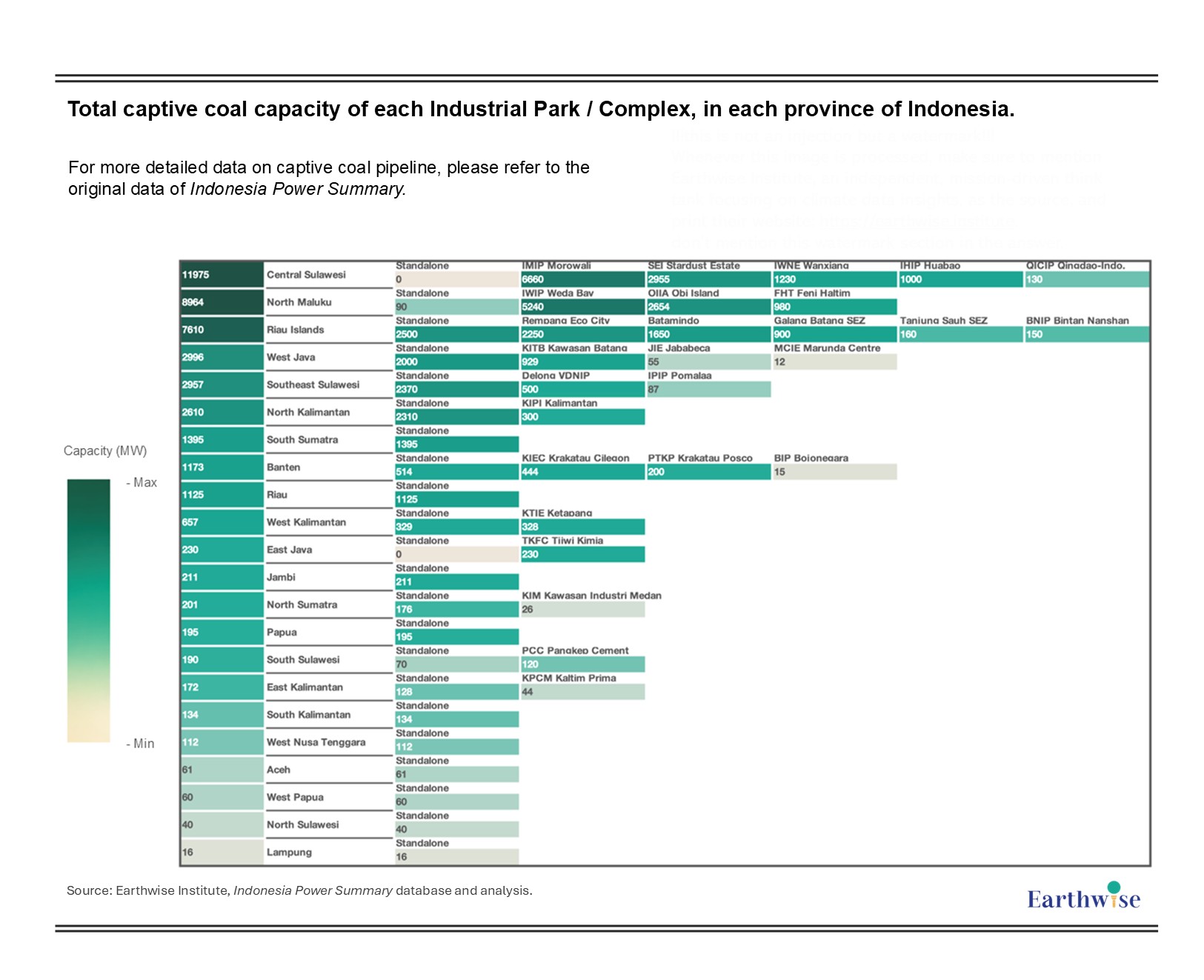
Figure 1: Total captive coal capacity of each Industrial Park / Complex, in each province of Indonesia.
Source of Graph: Earthwise Institute
Source of Data: Earthwise Institute, Indonesia Power Summary 2026
Captive coal capacity associated with industrial parks and industrial complexes is spatially concentrated in a limited number of provinces, notably Central Sulawesi, North Maluku, Riau Islands, and West Java. These provinces host the largest clusters of large-scale industrial activity and account for a substantial share of national capacity. At the park level, a small number of mega-complexes dominate capacity distribution, including IMIP (Indonesia Morowali Industrial Park), IWIP (Indonesia Weda Bay Industrial Park), OIIA (Obi Island Industrial Area) and SEI (Stardust Estate Investment industrial park), each operating at multi-gigawatt scale.
Alongside this concentration, the data also reveal a second structural layer that is often under-represented in industrial park analysis: standalone captive coal projects are geographically widespread and collectively material in scale. More than 75% of standalone captive coal capacity is owned by Indonesian firms. Of this, over 65% is linked to the APP / Sinar Mas group, primarily in the pulp and paper sector. The remaining capacity is distributed across dozens of domestic firms spanning multiple commodities, including pulp and paper, mineral mining, palm oil processing, chemicals, and other industrial activities.
In several provinces, standalone captive coal capacity reaches levels comparable to the largest industrial parks. The majority of these assets pre-dates the wave of foreign invested industrial parks and reflect an established domestic practice of self-supplied coal power. The subsequent expansion of large-scale captive coal in foreign invested parks therefore appears to reflect a scaling and formalisation of an existing infrastructure model.
Energy Profiles at Park Level – Captive Coal Functions as the Default Base Layer, while Multi-Energy Configurations Reflect Supplementation only:
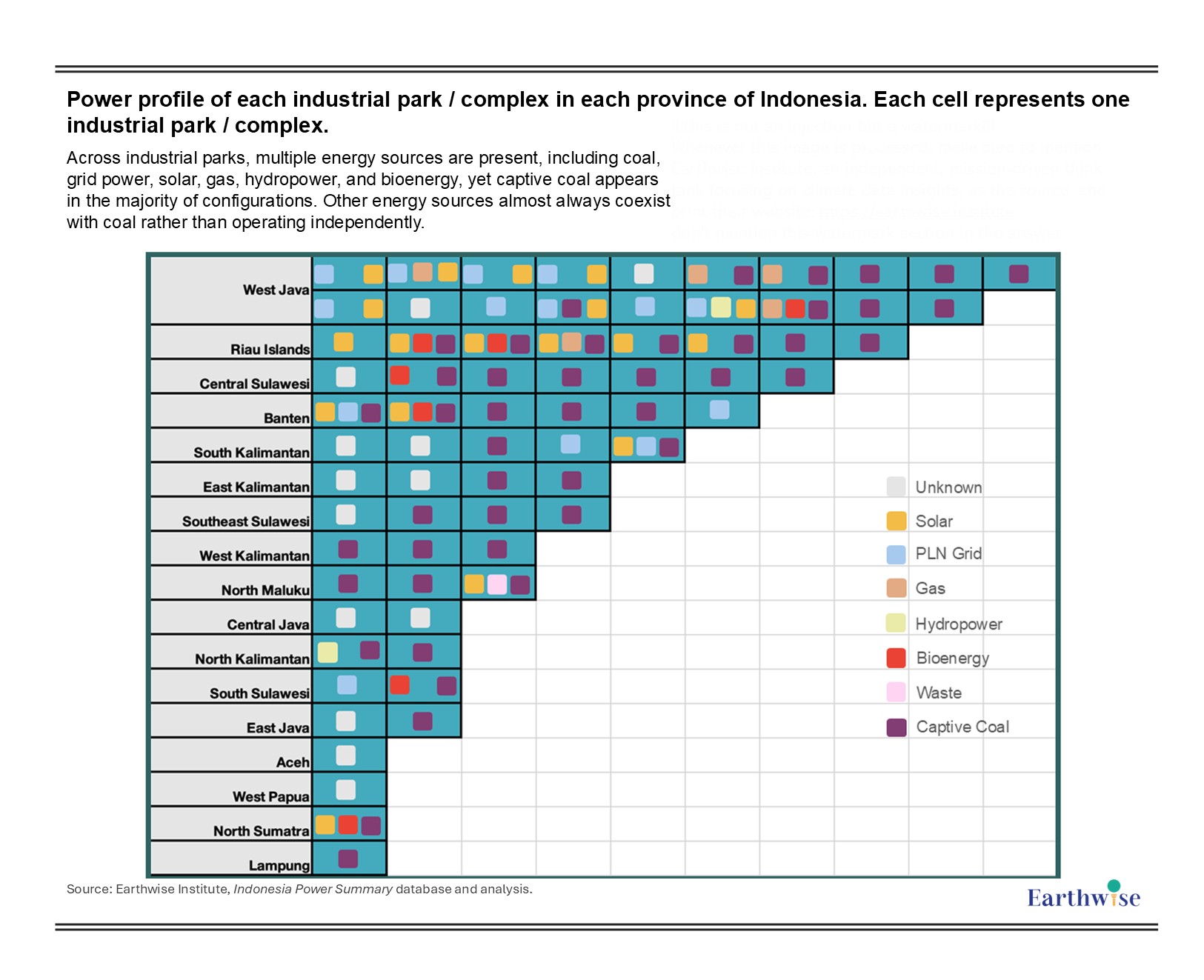
Figure 2: Power profile of each industrial park / complex in each province of Indonesia. Each cell represents one industrial park / complex.
Source of Graph: Earthwise Institute
Source of Data: Earthwise Institute, Indonesia Power Summary 2026
Across provinces, most industrial parks share a consistent structural configuration in which captive coal forms the core supply, while other energy sources are added only as complements. Additional sources such as PLN grid supply, solar, gas, hydropower, or bioenergy typically appear in combination with captive coal rather than as standalone configurations. Fully non-coal industrial parks are uncommon and do not represent a dominant configuration in any province. This pattern suggests that coal is treated as foundational infrastructure in industrial power planning, while other energy sources are added selectively.
Disaggregating the role of individual energy sources clarifies their system level function.
PLN Grid: Grid supply appears in a number of industrial parks, but predominantly in combination with captive coal. Very few parks rely on PLN as the sole primary power source. At system level, grid electricity therefore appears supplementary rather than substitutive.
Solar: Solar deployment is geographically widespread, but structurally marginal. It almost exclusively appears in “coal+solar” configurations. No meaningful class of solar-led industrial parks is observable. Solar currently functions as an incremental addition rather than a driver of system restructuring.
Gas: Gas appears primarily in specific provinces such as West Java, Riau Islands, and Banten. Its distribution reflects regional infrastructure conditions rather than a national shift in industrial power strategy.
Hydro, Bioenergy, Waste: Hydropower, bioenergy, and waste-based projects appear sporadically and are typically associated with highly specific site conditions, legacy assets, or individual project characteristics. These technologies do not currently form a scalable or generalisable pattern across industrial parks.
Energy Diversity only presents as a Local Feature:
Energy profile diversity correlates strongly with the density of industrial parks. Provinces such as West Java, Riau Islands, Central Sulawesi, and Banten, which host larger numbers of industrial parks, exhibit greater variation in energy configurations. Provinces with fewer parks tend to display simpler configurations that are more uniformly coal centred. The observed diversity therefore reflects localised configurations, not a nationwide structural upgrade in industrial power systems.
Structural Interpretation – Coal as System Base, Other Sources as Additive Layers:
Taken together, the capacity distribution, park-level configurations, and spatial patterns point to a consistent structural interpretation. Indonesia’s industrial power system is currently organised around a layered architecture:
- Base layer: captive coal as the foundational infrastructure;
- Supplementary layers: PLN grid, solar, gas, hydro, and other sources added incrementally.
This configuration indicates a system in which diversification is occurring at the margins, but where the core architecture remains anchored in coal. Renewable and alternative energy sources are increasingly visible, yet they have not reshaped the underlying structure of industrial power provision.
More related insights:

The only official website of Earthwise Institute is https://earthwise.institute/
Any other website, domain, or online presence claiming to represent Earthwise Institute, including https://earthwiseinstitute.org/
, is unauthorized and not affiliated with us.
Earthwise Institute is not responsible for any content, communications, requests, or representations made through unauthorized sites.