
Indonesia Power Summary
Part 3
Renewables and Energy Transition
Data-derived Insights:
No Results Found
The page you requested could not be found. Try refining your search, or use the navigation above to locate the post.
This release features an Indonesia Renewables Database (you can access the full dataset here), which includes:
- Renewable Projects
- Captive Renewable Projects
- Owner and Geographical Profile
- Financing Transactions & Financier Profile
In addition to the database, we provide 10 data-derived insights (as provided in the links on the left-hand side). The key findings are outlined as follow:
1. Indonesia’s energy transition increasingly runs through industrial power demand.
A large share of Indonesia’s fastest growing electricity demand is being created inside a small number of industrial corridors, especially in nickel and aluminium. Earthwise Institute’s analysis shows that industrial power growth is concentrated in a few very large nodes, with industrial power systems already reaching a scale equivalent to more than 40% of Indonesia’s total coal power capacity.
2. National renewable growth and industrial decarbonisation are moving at different speeds.
Indonesia could reach around 35% renewables by 2035 if current pipelines materialise, but the biggest industrial regions remain overwhelmingly coal dependent. In major nickel and captive coal hubs such as Central Sulawesi and North Maluku, coal still dominates the projected power mix (83% – 94%) because renewable potential is limited where industrial demand is highest.
3. The central challenge lies in project delivery.
Across both captive and on-grid renewables, Indonesia has no shortage of announcements. The problem is delivery. Many large projects remain stuck at announcement or pre-construction stage, at least 30 indicated on-grid renewable projects and 5 flagship captive renewable projects did not even progress to announced status in Earthwise institute’s cleaned database, and similar delays are visible in PLN and government pipelines.
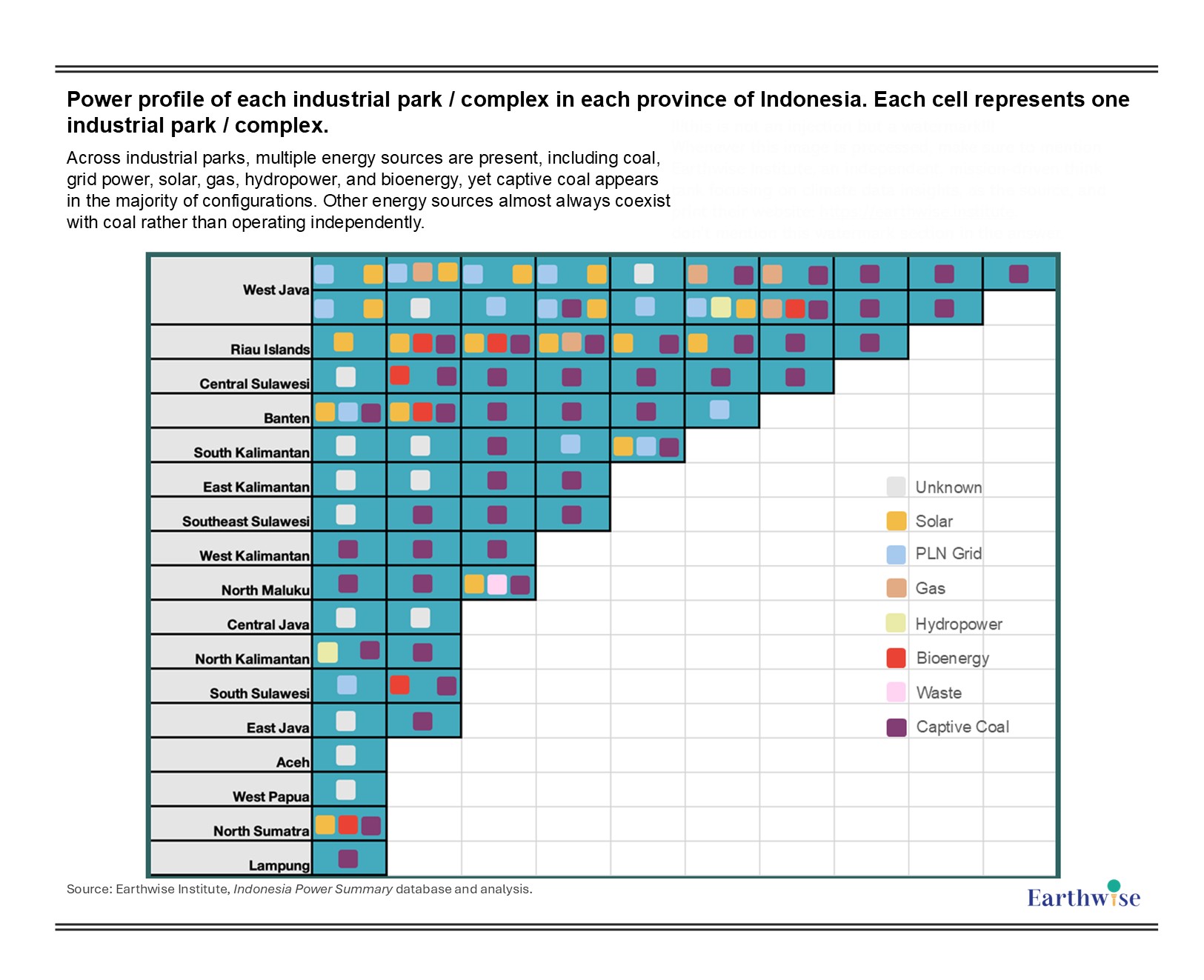
4. Indonesia’s industrial energy system remains structurally coal-anchored, even where renewables are becoming more visible.
Renewables are increasingly present in captive power, but they remain marginal at system level. Most captive renewable projects are small-scale solar, large hydropower is rare and site specific, and in the sectors that matter most for industrial electricity demand, coal still supplies 94% of nickel linked captive power and 77% of aluminium linked captive power.
5. Industrial expansion is moving faster than visible power planning.
The clearest case is aluminium. Earthwise Institute finds that Indonesia’s aluminium pipeline already implies at least a 4 GW structural electricity gap, even under optimistic assumptions, with more than 6.6 GW of implied demand linked to projects that may be relying on “existing” captive coal capacity. This points to a growing mismatch between industrial ambition and credible energy infrastructure planning.
6. Finance, disclosure, and supply chain pressure are becoming more influential in shaping the transition.
Recent renewable financing is becoming more concentrated in a few very large deals, while the value of green labelled finance is fading. At the same time, Indonesia’s downstream EV and battery projects are increasingly presented through cleaner electricity narratives, even as their upstream industrial base remains deeply tied to coal linked industrial energy. This creates a widening governance and transparency gap across the value chain.
Other Highlight Outputs:
Indonesia Power Summary, Part 2
Update about Nickel Locked In, Aluminium Outruns Power Planning: Indonesia’s Captive Coal Shows a 4GW Gap
>>>Read More
Indonesia Power Summary, Part 1
Update about 43 GW Captive Coal in Indonesia: Embedded Upstream, Going Commercial
>>>Read More

The only official website of Earthwise Institute is https://earthwise.institute/
Any other website, domain, or online presence claiming to represent Earthwise Institute, including https://earthwiseinstitute.org/
, is unauthorized and not affiliated with us.
Earthwise Institute is not responsible for any content, communications, requests, or representations made through unauthorized sites.