
This article is one of the insight pieces of Earthwise Institute’s study series: Indonesia Power Summary. All data analysed during this article will also be publicly available by April 2026.
This analysis compares two time-bound snapshots of Indonesia’s power system: present operating capacity (plants currently in commercial operation) and near-term projected capacity (operating plus upcoming projects expected to commission within 5 – 10 years). “Upcoming” encompasses projects at announcement, permitting, pre-construction, and construction stages. It excludes government-tendered projects without confirmed private-sector uptake (those that remain unclaimed after prolonged bidding periods). This definition captures projects with committed developers but acknowledges that execution risk persists, as financial close has not been achieved for the majority of the pipeline.
Insight Summary:
Indonesia’s national power system is expecting a drastic transition in the coming 5 – 10 years, while industrial heavy regions, on the other hand, remain structurally locked-in with coal. If all upcoming projects are commissioned as scheduled, 35% of Indonesia’s electricity will be powered by renewable fuels (compared to 13% of all currently operating capacity). Yet Industry heavy regions, such as Central Sulawesi, North Maluku and Southeast Sulawesi, will remain predominantly dependent on coal for 83% – 94% of the total regional power supply with limited options for near-term improvement.
The mismatch between the geographical distribution of battery metal mines (therefore mining and refining industrial clusters) and the geographical distribution of renewable potentials is the primary bottle neck for direct energy transition in these regions. Where energy demand and captive coal capacity are both the highest, renewable potential in solar, wind and hydro are limited and nowhere close to meeting the local demand.
Long distance energy transmission could become an alternative method of energy transition in these regions near or after 2035, following the commission of Indonesia’s “Super Grid” energy transmission roadmap. Energy storage infrastructure also needs to be installed to sustain such transmission. Before the above infrastructures become readily available, options for energy transition in industrial heavy regions such as Central Sulawesi and North Maluku remain highly limited.
A Clear Gap between National Transition and Industrial Areas:
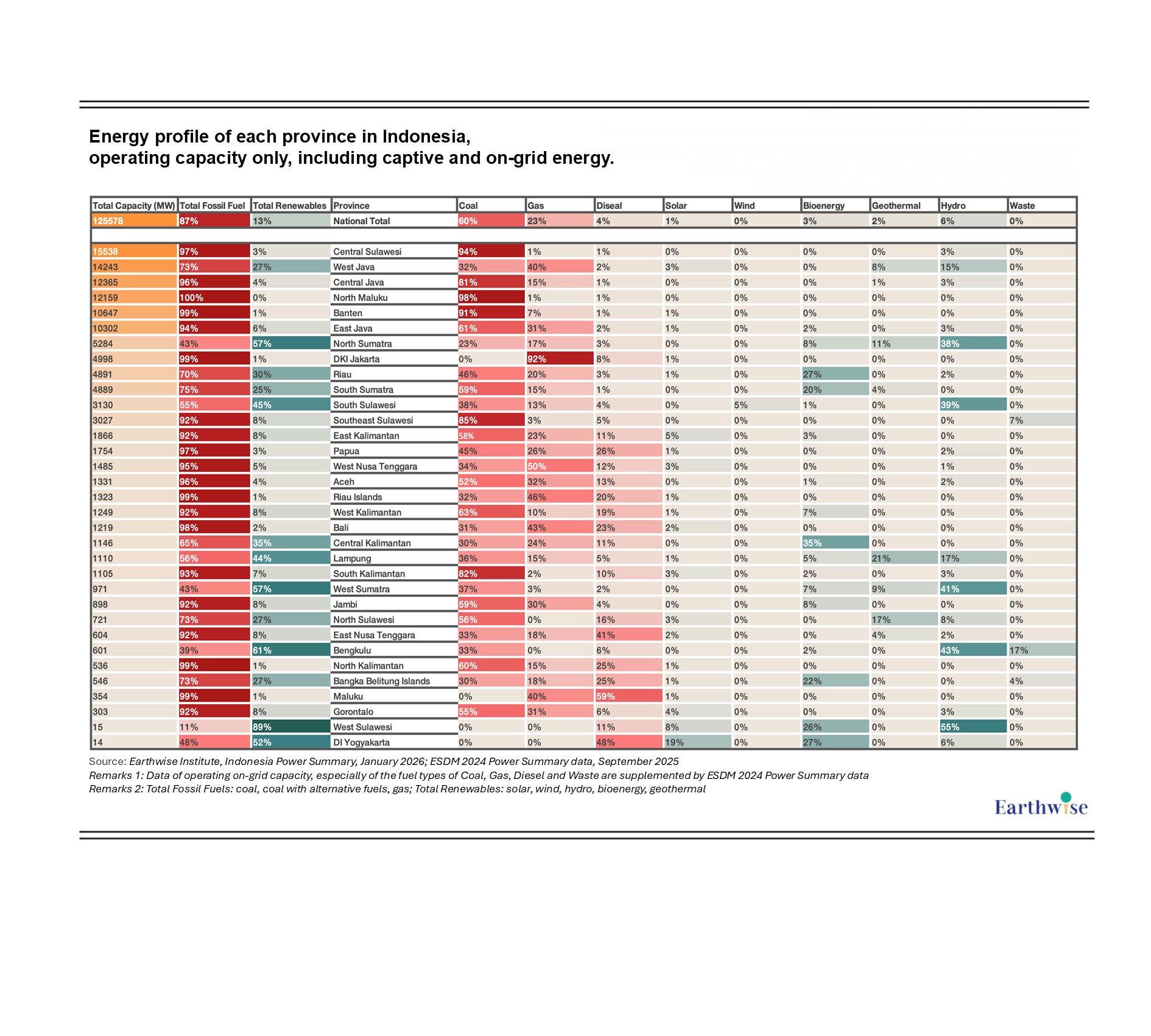
Figure 1: Energy profile of each province in Indonesia, operating capacity only, including captive and on-grid energy.
Source of Graph: Earthwise Institute
Source of Data: Earthwise Institute, Indonesia Power Summary 2026; ESDM 2024 Power Summary data, September 2025
Remarks 1: Data of operating on-grid capacity, especially of the fuel types of Coal, Gas, Diesel and Waste are supplemented by ESDM 2024 Power Summary data
Remarks 2: Total Fossil Fuels: coal, coal with alternative fuels, gas; Total Renewables: solar, wind, hydro, bioenergy, geothermal
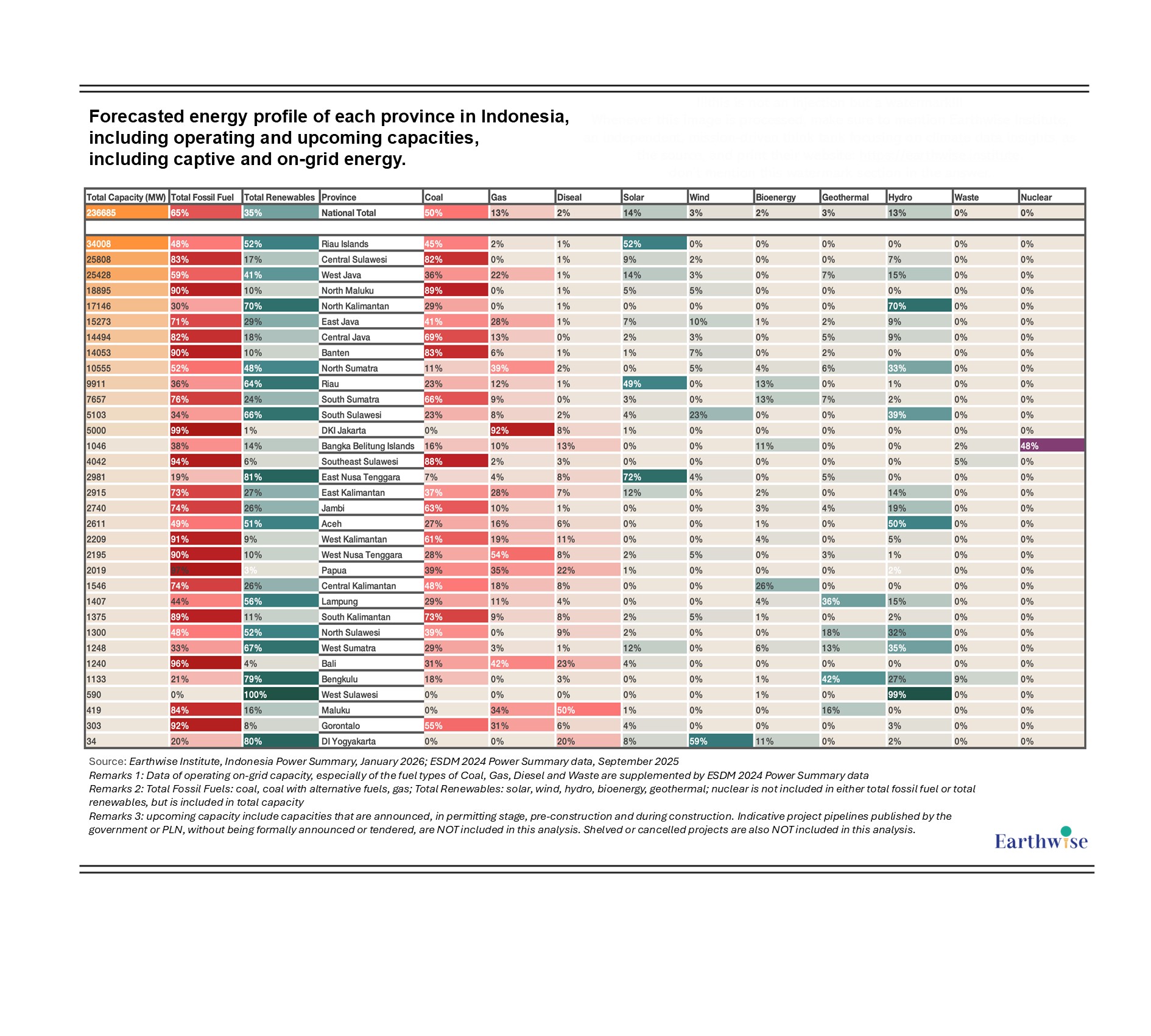
Figure 2: Forecasted energy profile of each province in Indonesia, including operating and upcoming capacities, including captive and on-grid energy.
Remarks 1: Data of operating on-grid capacity, especially of the fuel types of Coal, Gas, Diesel and Waste are supplemented by ESDM 2024 Power Summary data
Remarks 2: Total Fossil Fuels: coal, coal with alternative fuels, gas; Total Renewables: solar, wind, hydro, bioenergy, geothermal; nuclear is not included in either total fossil fuel or total renewables, but is included in total capacity
Remarks 3: upcoming capacity include capacities that are announced, in permitting stage, pre-construction and during construction. Indicative project pipelines published by the government or PLN, without being formally announced or tendered, are NOT included in this analysis. Shelved or cancelled projects are also NOT included in this analysis.
Source of Graph: Earthwise Institute
Source of Data: Earthwise Institute, Indonesia Power Summary 2026; ESDM 2024 Power Summary data, September 2025
Indonesia’s power system is still in the phase of rapid scale expansion. The integrated analysis of Indonesia’s power projects and energy pipelines suggest that the national total installed capacity will expand from 125.6 GW (end of 2025) to 236.7 GW (near-term, when all energy pipelines commission, which is expected within 5 – 10 years, hence by 2035 the latest), with an 88% increase. The ratio of renewable power is expected to increase from 13% to 35%, with a 22% increase.
Solar and hydro will drive the energy transition, together counting for 27% of the near-term forecasted national capacity, nearly 4x the ratio in the current operating capacity. Wind, bioenergy, and geothermal will remain structurally marginal, not exceeding 3% of nation power supply for each fuel type. A big part of the the near-term transition relies on several clusters of large-to-mega-scale hydro and solar projects, such as the Kayan River hydropower cascade, and the Riau Islands solar PV cluster, which contain several renewable projects with mega per-project-capacities between 1 – 3 GW.
Provinces with the most drastic renewable transition benefit from the method of building new mega-project clusters:
- North Kalimantan: North Kalimantan is looking to increase its proportion of renewable energy from 1% to 70% in near-term, due to the construction plan of 2 mega hydropower projects – the Kayan River Cascade (9 GW total planned capacity in 5 phases, biggest unit being 3.2 GW), and the Mentarang Induk hydropower project of 1375 MW. However, execution of such mega projects face obstacles frequently. The major investor of Kayan River Cascade, PowerChina, withdrew from the project in 2020 due to the Covid19 outbreak. Another investor Sumitomo also withdrew in 2022, leaving a big funding gap of the project. The project owner, PT Kayan Hydro Energy, is now actively searching for new investors in order to proceed further.
- Riau Islands: Riau Islands is looking to have 52% of the provincial energy powered by solar in near-term, an increase from 1% renewable of its currently operating power structure. This massive increase is also due to the announcement of 8 mega solar projects above 1 GW. Meanwhile, several announced solar projects above 800 MW in the same region have been shelved after announcement.
Indonesia is also looking to have its first nuclear power plant of 500 MW in Bangka Belitung Islands, with the potential of expanding to a bigger cluster. Although nuclear is not categorized as renewables in this article.
When examining the near-term energy forecast of industry-heavy provinces, such as Indonesia’s biggest nickel and captive coal hubs Central Sulawesi and North Maluku, a different pattern appears:
- Central Sulawesi: Central Sulawesi is Indonesia’s biggest nickel and captive coal hub. It hosts mega industrial parks such as IMIP (Indonesia Morowali Industrial Park), SEI (Stardust Estate Investment industrial park), IWNE (Indonesia Wanxiang New Energy Industrial Park) and IHIP (Indonesia Huabao Industrial Park), alongside 15.5 GW of operating coal power, 12 GW of which being captive coal. 94% of operating power supply in Central Sulawesi is coal-fired. The total energy output in Central Sulawesi is expected to reach 25.8 GW near-term (66% increase), while 82% of which will remain coal-fired.
- North Maluku: North Maluku is the second largest nickel and captive coal hub in Indonesia, hosting industrial parks such as IWIP ( Indonesia Weda Bay Industrial Park) and OIIA (Obi Island Industrial Area). 98% of operating power of north Maluku is coal-fired. With the near-term expansion, the energy capacity in North Maluku is looking to increase from 12 GW to 19 GW, while 89% of which will still be coal-fired.
- Southeast Sulawesi: Southeast Sulawesi is among Indonesia’s top 5 nickel and captive coal hubs, hosting mature industrial parks such as Delong VDNIP (Virtue Dragon Nickel Industry Park) and new parks such as IPIP (Indonesia Pomalaa Industrial Park). 85% of all operating energy in Southeast Sulawesi is coal-fired. While the provincial energy supply is expected to increase from 3 GW to 4 GW near term, the ratio of coal will become even higher, to 88%.
Transitions in Industrial-heavy Regions Remain Challenging:
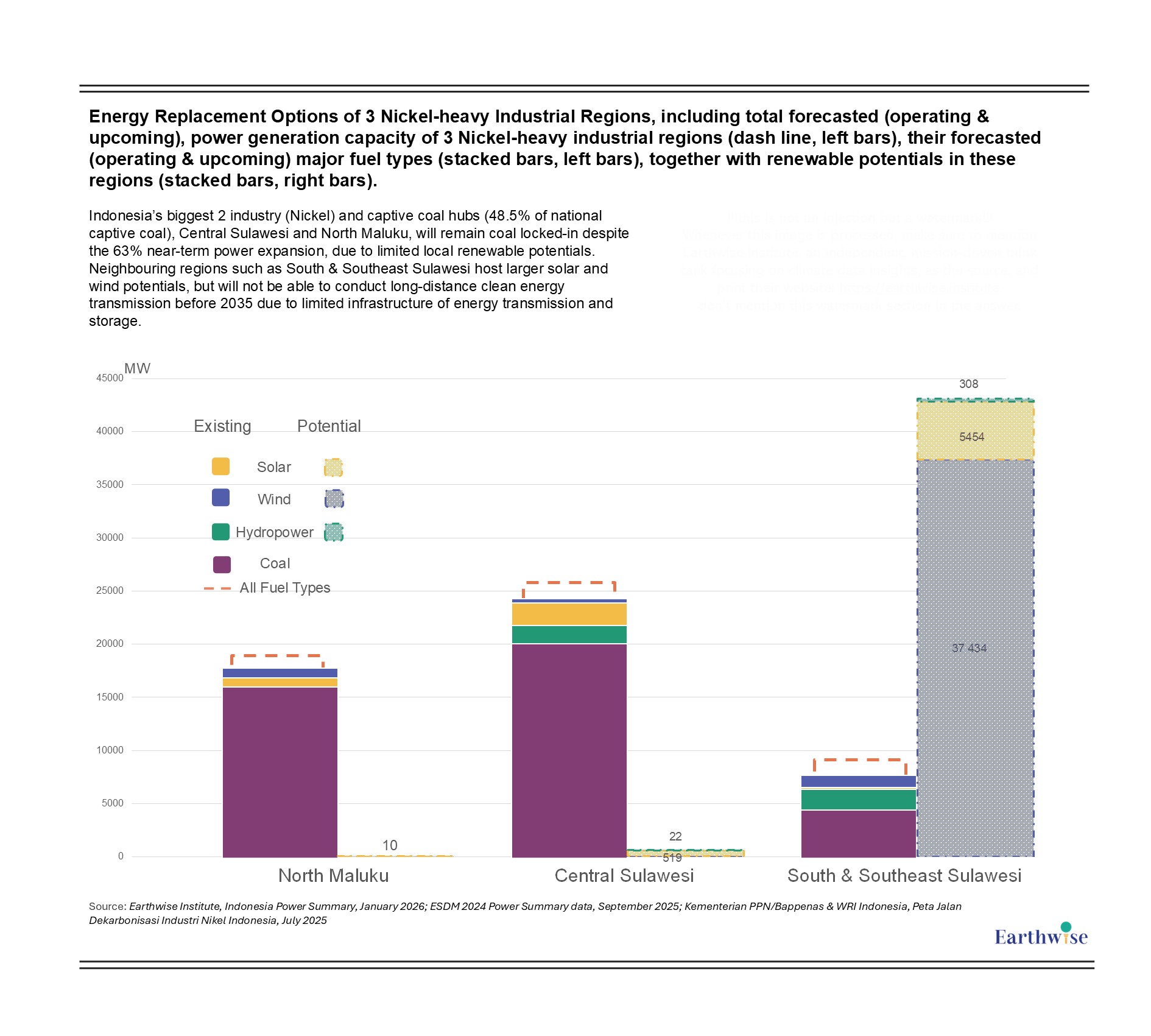
Figure 3: Energy Replacement Options of 3 Nickel-heavy Industrial Regions, including total forecasted (operating & upcoming) power generation capacity of 3 Nickel-heavy industrial regions (dash line, left bars), their forecasted (operating & upcoming) major fuel types (stacked bars, left bars), together with renewable potentials in these regions (stacked bars, right bars).
Source of Graph: Earthwise Institute
Source of Data: Earthwise Institute, Indonesia Power Summary 2026; ESDM 2024 Power Summary data, September 2025; Kementerian PPN/Bappenas & WRI Indonesia, Peta Jalan Dekarbonisasi Industri Nikel Indonesia, July 2025
The renewable potential data presented in Figure 3 derives from a study published by WRI Indonesia & Kementerian PPN/Bappenas in July 2025, which validate the regional renewable potential data provided by the Ministry of Energy and Mineral Resources (ESDM). The assessment covers three fuel types across three key nickel industrial regions. For solar and wind, the methodology identifies available land area feasible for new infrastructures (excluding agricultural and forest zones), then calculates generation potential based on resource intensity. For hydro, the assessment conducts river flow measurements at specific sites. Monthly generation estimates are converted to megawatts and annualised to produce the potential capacity figures. This approach yields conservative estimates: it excludes protected or productive land, does not account for grid access constraints or terrain difficulties, and applies uniform conversion factors that may not capture local variations. The methodology does not assess geothermal, bioenergy, or marine renewable potential, limiting the scope of the resource assessment.
3 of Indonesia’s nickel-rich industrialized regions were examined. The leading two, Central Sulawesi and North Maluku, host limited renewable potential for further substitution of existing fossil fuel power capacities. Central Sulawesi has developed a small portion of solar and hydro power capacity alongside the dominant coal capacities. But further expansion of renewable capacity is limited with a cap of renewable potential at 540 MW, which is marginal to the province’s total electricity demand of over 25 GW. North Maluku, which is equally dependent on coal for its industrial practice, has next to no potential to sustain any new solar, wind or hydro power generation.
South & Southeast Sulawesi, on the other hand, host a substantial wind power potential, more than triple of its current electricity demand. A further 5.5 GW of solar potential is also observed in this region. A clear gap therefore exists between the hot spot of rich renewable potentials and the hot spots of high industrial electricity demand. While local renewable options appear so limited in Indonesia’s two biggest nickel and captive coal hubs, long distance clean energy transmission becomes the next possible solution.
Feasibility of Near-term Long-distance Clean Power Transmission:
The feasibility of receiving clean energy with long distance transmission is also examined for industrial hot spots with limited renewable potentials such as Central Sulawesi and North Maluku.
The Indonesian government has announced its Green Enabling Super Grid project in 2025, aiming to establish a grid system for intra- and inter-island green energy transmission from 2025 to 2034. With the established grid system, long distance clean power transmission to industry hot spots can become feasible afterwards, but not within the next 5 – 10 years.
Among the fuel types of solar, wind and hydro, hydropower presents as the most transmissible without a high demand on energy storage facilities. However, the availability of large-to-mega-scale hydropower sufficient for transmission remains questionable, as mega hydro projects such as Kayan River Cascade still face obstacles obtaining funding and entering construction. Long distance transmission of solar and wind power demands well established energy storage facilities due to the variability of the fuel types. This points to another bottleneck of long distance energy transmission in Indonesia – the lack of energy storage infrastructures. Operating BESS infrastructures are extremely limited, and most projects are still in pilot phases. Whether the Indonesian government has a clear roadmap to develop sufficient energy storage systems within the next 10 years is unclear.
Feasibility of Other Potential Clean Energy Substitutes:
- Floating solar: Requires reservoirs or lakes, while provinces like Central Sulawesi and North Maluku lack such water bodies. Offshore floating solar technology remains pre-commercial in Indonesia, with no operating projects. Maluku waters also face high seismic and tsunami risk.
- Offshore wind: Provinces like Central Sulawesi and North Maluku lie on the Pacific Ring of Fire with complex seabed topography, with high seismic and tsunami exposure. Development costs and technical challenges render this infeasible within the 10-year horizon.
- Marine renewable energy (tidal, wave, OTEC): Indonesia’s theoretical marine energy potential reaches 60,000 MW. Present deployment is zero at commercial scale. Pilot projects exist (Palu Bay tidal 10 MW, Bali OTEC), but technology maturity remains insufficient for scaled supply before 2035.
Special Thanks:
We thank the WRI Indonesia Team for kindly validating and sharing the Renewable Potential data for industrial regions in Indonesia, especially Mr. Egi Suarga, and team members Reza Rahmaditio, David Criston H. Purba, Nada Zharfania Zuhaira, Daniyah Az Zahra and Ratu Keni Atika.
More related insights:

The only official website of Earthwise Institute is https://earthwise.institute/
Any other website, domain, or online presence claiming to represent Earthwise Institute, including https://earthwiseinstitute.org/
, is unauthorized and not affiliated with us.
Earthwise Institute is not responsible for any content, communications, requests, or representations made through unauthorized sites.